Board of Directors
Composition of the Board of Directors
The shareholders’ meeting elects and removes the members and the Chair of the BoD. Shareholders representing at least 0.5% of the share capital or the voting rights may propose a candidate for the BoD, to be put on the agenda of the General Meeting, provided the request is made at least 45 calendar days in advance of the General Meeting and provided it is made in due form. The Nomination and Compensation Committee (NCC) proposes potential BoD succession candidates. It strives for a BoD composition with appropriate professional backgrounds and experience as well as diversity among the members of the BoD. The members of the BoD, the BoD chair and the members of the NCC are each elected individually and annually by the ordinary shareholders’ meeting. The term of office ends at the closing of the next ordinary shareholders’ meeting and re-elections are possible.
The NCC has a mandate for succession planning of BoD members, which also considers the representation of both genders in the BoD. However, at this stage, extraordinary factors relating to the acquisition of the Crayon group are taken into consideration. The combination and subsequent integration of the SoftwareOne and Crayon businesses is a unique situation, in which the representation of founders of both the SoftwareOne and Crayon businesses in the BoD is especially beneficial. The integration of both businesses is a large-scale cultural change process, during which the continued engagement of the founders in the BoD greatly supports the motivation and engagement of the workforce. For this reason, the BoD has prioritized founder representation over other factors considered for Board composition at this stage.
During the reporting period, the following members formed part of the BoD. As at December 31, 2025, the BoD consisted of seven members.
Name | Nationality | Born | First elected | Significant shareholder | Education | Background |
Till Spillmann Chair1) | Swiss | 1977 | 2024 | No | Law, private equity | Argon Management AG, PMT Management AG, ImmoMentum AG |
Andrea Sieber | Swiss | 1976 | 2024 | No | Law | Attorney, partner MLL Legal AG |
Daniel von Stockar2) | Swiss | 1961 | 2013 | Yes | Economics | Entrepreneur, Founder SoftwareOne |
Jens Rugseth3) | Norwegian | 1962 | 2025 | No | Economics | Crayon Group, Techstep ASA, Spir Group ASA, Karbon Invest AS |
Jörg Riboni | Swiss | 1957 | 2024 | No | Economics and finance | Former CFO Emmi AG, Forbo Holding AG, Jelmoli AG |
René Gilli | Swiss | 1958 | 2024 | Yes | Economics and information technology | Entrepreneur, Founder SoftwareOne |
Rune Syversen3) | Norwegian | 1968 | 2025 | No | Economics | Crayon Group Telenor Group, Link Mobility Group Holding ASA, Karbon Invest AS |
1)Elected as Chair at the AGM held on May 16, 2025.
2)Stepped down as Chair at the AGM held on May 16, 2025.
3)Elected by the AGM held on 16 May 16, 2025, subject to the closing of the Crayon Group acquisition, which became effective on July 2, 2025.
Individual members of the Board of Directors
ESRS 2 GOV-1 21(c)

more details

more details

more details

more details

more details

more details

more details
External mandates
Availability and statutory provisions regarding external mandates
SoftwareOne’s Articles of Incorporation (AoI) provide for the company’s BoD being composed of no fewer than three and no more than 12 members, including the Chair of the BoD.
As per Art. 21 of the AoI, no member of the BoD may hold more than four additional mandates at listed companies or more than six mandates at non-listed companies.
Mandates within the meaning of this provision are mandates for comparable functions at other companies with a commercial purpose. Mandates at different legal entities under common control or owned by the same beneficial owner are deemed to constitute a single mandate.
The following mandates are not subject to these limitations:
- Mandates at companies that are controlled by the company or that control the company;
- Mandates held at the request of the company or companies it controls. No member of the BoD or of the EB may hold more than 10 such mandates;
- Mandates at associations, charitable organizations, foundations, trusts, and employee welfare foundations. No member of the BoD or of the EB may hold more than six such mandates.
All members of the BoD remained within the statutory maximum numbers of outside mandates at listed and non-listed companies and organizations. The following table shows attendance at meetings as well as outside mandates of BoD members:
External mandates | |||||
Name | Board meetings | Audit Committee meetings | Nomination and Compensation Committee meetings | listed4) | non-listed4) |
Till Spillmann1) | 17/18 | 7/12 | 4/9 | 0 | 4 |
Andrea Sieber | 17/18 | – | 9/9 | 2 | 4 |
Daniel von Stockar2) | 17/18 | 11/12 | – | 0 | 4 |
Jens Rugseth3) | 8/18 | 5/12 | – | 2 | 4 |
Jörg Riboni | 18/18 | 12/12 | – | 0 | 3 |
René Gilli | 15/18 | – | 9/9 | 0 | 2 |
Rune Syversen3) | 8/18 | – | 4/9 | 1 | 5 |
Average meeting length | 2:50h | 2:30h | 1:50h | ||
1)Elected as Chair at the AGM held on May 16, 2025.
2)Stepped down as Chair at the AGM held on May 16, 2025.
3)Elected by the AGM held on May 16, 2025, subject to the closing of the Crayon Group acquisition, which became effective on July 2, 2025.
4)The maximum number allowed at listed companies is four, and six for non-listed companies.
Compensation of the Board of Directors
The shareholders’ meeting votes annually on the proposals of the BoD in relation to the maximum aggregate compensation of the BoD for the period until the next ordinary shareholders’ meeting. The compensation of the members of the BoD consists of an annual base fee and an additional amount awarded for duties performed on BoD committees as Chair or ordinary members. In line with Art. 18 of SoftwareOne’s Articles of Incorporation (AoI) and to ensure the independence of the members of the BoD in executing their supervisory duties, the compensation of the members of the BoD consists of a fixed amount determined in advance and is not dependent on SoftwareOne’s annual performance metrics. Based on peer group benchmarking as described in the Compensation report, the compensation is in accordance with best market practice standards.
Effective from the 2020 AGM, the BoD’s total compensation has been paid out 60% in cash and 40% in SoftwareOne shares, subject to a three-year blocking period, to strengthen the long-term focus of the BoD and align the BoD members’ interests with those of shareholders. SoftwareOne considers that this structure appropriately balances the need for BoD independence with the long-term alignment of BoD and shareholder interests. The three-year blocking period ensures that BoD members maintain a long-term perspective aligned with sustainable value creation. No options are issued to BoD members. More details on compensation and post-employment benefits of the BoD can be found in the Compensation report.
The members of the BoD may only be granted loans and credits up to a maximum amount of CHF 1,000,000 at market-based conditions and in compliance with the applicable rules of abstention. No loans were granted to the BoD members, and no loans are outstanding.
Social security-related payments on behalf of the BoD are limited to legal requirements.
Rules in the Articles of Incorporation regarding compensation
Please refer to the AoI and the Compensation report for further information on the additional amount for compensation of members of the EB appointed after the vote of the AGM on compensation, and also loans, credits, and pension benefits of BoD members and members of the EB. These comply with the rules in the AoI concerning the principles on performance-related compensation and on the allocation of equity securities, conversion rights, and option rights.
Environmental, Social and Governance (ESG)
SoftwareOne’s ESG program is designed to achieve the company’s ambitions for a sustainable future. With BoD oversight and support, senior leadership leads the integration of the company’s business and ESG strategies, as well as the implementation of ESG initiatives.
Further details are contained in the Report from our BoD:
- See the section Our approach to sustainability.
- See the sections Sustainability governance and Value creation through our strategy and business model in ESRS 2.
Interaction with shareholders and stakeholders
A key mandate of the BoD is to build and maintain ongoing dialogue with its shareholders and other stakeholders. Engagement meetings with investors and proxy advisors on matters beyond financial and strategy issues, such as governance, compensation, and corporate social responsibility, are steered by the Chair of the BoD or the Chair of the Nomination and Compensation Committee, supported by the Chief Legal Officer and the Chief Human Resources Officer or the Head of Group Compensation and Rewards.
Specific Board activities during the reporting period
The BoD meets at least six times per year (four quarterly report meetings, a strategy meeting, and a medium-term planning and budgeting meeting); meetings are held in person but can also be held via telephone, video conference, or other electronic media. In 2025, the BoD held seven ordinary and, in the second half of the year, 10 extraordinary meetings, with an average length of approximately 2:50 hours. Of the seven ordinary BoD meetings, six were held by video conference. An informal strategy meeting, also held in person, addressed how to foster good overall corporate governance. Further focus was placed on company performance and integrity as well as on company strategy and how to best incorporate and deliver technological advances to the company and its customers.
Average attendance at BoD meetings in 2025 was approximately 95% (for individual attendances, see section Availability and External mandates).
In addition to the regular meeting agenda items, in 2025 the BoD specifically focused on topics such as:
- Market trends as well as setting and achieving company strategy and targets;
- Customer and technological trends, including generative AI products;
- Global talent acquisition and succession planning;
- ESG strategies and projects;
- Audit Committee and Nomination and Compensation Committee matters;
- Engagement with institutional investors;
- The acquisition of the Crayon Group and the subsequent integration.
Board of Directors’ internal organization
The legal foundation of the BoD’s responsibilities is provided by Art. 716a of the Swiss Code of Obligations.
The BoD has a supervisory role and takes strategy, finance and personnel decisions in accordance with the law, the AoI and the OrgR. It also supports, advises, and encourages management. The overall guiding principles for the BoD are full accountability to all shareholders and stakeholders of SoftwareOne and an approach marked by a culture of openness and mutual respect.
The BoD has delegated certain responsibilities, including the preparation and execution of resolutions, to two committees. Responsibility for the duties and powers assigned to these committees is retained by the BoD.
The BoD has established the following two standing committees:
- Audit Committee (AC);
- Nomination and Compensation Committee (NCC).
Each standing committee consists of a Chair and at least two other members of the BoD. The NCC consists of three members who are elected annually by the General Meeting of shareholders. The duties and authorities of the committees are set out in the Audit Committee Charter and the Nomination and Compensation Committee Charter, respectively, as well as in SoftwareOne’s OrgR. The committees’ operating principles are aligned with and complementary to those applicable to the BoD as a whole.
The ad hoc Transaction Committee, established in 2024 to evaluate a potential sale and going private and/or the potential acquisition of the Crayon Group, was discontinued, as its mandate had been fulfilled. Its responsibilities were reintegrated into the full Board. The committee did not hold any meetings in 2025.
BoD committees are structured non-redundantly, and working topics are clearly assigned and handled by only one committee. The BoD Chair coordinates committee work in case of potential overlaps. All materials used in BoD committee meetings are made available to all BoD members, who are invited to contact the committee Chair, the BoD Chair, or the Co-CEOs with any clarifying questions (exceptions may apply to materials of the NCC). The BoD has established the additional key positions of Vice Chair and Lead Independent Director, whose duties and competencies are described in the OrgR in the sections Vice Chair of the BoD and Lead Independent. The functions of the Vice Chair and the Lead Independent Director can be combined and performed by the same BoD member. The Vice Chair or Independent Lead Director will chair the BoD and any General Meeting in the absence of the Chair.
Chair of the Board of Directors
The Chair is entrusted with leading and managing the BoD and is responsible for establishing an appropriate structure and governance system that enables the BoD to perform its duties efficiently and in the best interests of the company. The Chair encourages alternative views and constructive dissent, leveraging individual insights of BoD members while keeping the focus on the agenda topics and driving aligned decision-making.
The Chair further represents the opinions and views of the BoD to SoftwareOne’s internal and external stakeholders. In exercising these duties, the Chair is guided by SoftwareOne’s conflict of interest policies and is supported by the Lead Independent Director if required.
In cooperation with the Co-CEOs, the Chair ensures the flow of information on all aspects of the company relevant to meeting preparation. Deliberations and decision-making are made available to all members of the BoD. In case of an emergency, when immediate action is required to safeguard the interests of the company, and where a regular BoD resolution cannot be reasonably passed in due time, the Chair, together with the Co-CEOs or any other appropriate member of the BoD or the EB, has the power to make all decisions and actions otherwise reserved for the BoD. If the Chair is absent, this power is assigned to the Vice Chair or the Lead Independent Director. The Chair promptly informs all members of the BoD of such decisions and actions, and they are confirmed and properly recorded in the minutes at the next meeting of the BoD.
The power and duties of the BoD Chair are set out in section 3.8 of the OrgR.
Vice Chair of the Board of Directors
The BoD assigns such powers and duties to the Vice Chair as it deems necessary (see Section 3.9 of the OrgR).
If the Chair is temporarily unable or unavailable to exercise the function, the Vice Chair either personally assumes the Chair’s duties or delegates them within the BoD or to suitable company representatives.
The Vice Chair has the right and duty to call meetings of the independent BoD members if they deem it necessary, especially if the independent decision-making process seems to be compromised. The Vice Chair also acts as the point of contact for BoD members and investors if they have concerns with respect to the independent decision-making process.
The BoD further provides the independent BoD members under the lead of the Vice Chair with financial resources to obtain external advice if this is deemed necessary by the Vice Chair to foster independent decision-making by the BoD.
Moreover, the Vice Chair supports the Chair in governance and strategy-related investor engagements. At the request of shareholders, the Vice Chair may carry out these engagements without the Chair.
Board of Directors’ independence assessment
The BoD generally defines the independence of members in line with the provisions of the Swiss Code. Accordingly, all non-executive members of the BoD who have never been a member of the EB (of the company or any direct or indirect subsidiary of the company), or who were members of the EB more than three years ago and have no or comparatively minor business relations with the company (or any direct or indirect subsidiary of the company), are considered independent.
The BoD is committed to ensuring independent decision-making and is aware that BoD members representing large shareholders, even if they are the company’s founders who continue to contribute to its prosperous development, may be considered non-independent. Through their casting votes, these two Chairs ensure independent decision-making by both committees.
Independent decision-making/conflict management
The Co-CEOs, CFO, and, as directed by the Co-CEOs, other EB members are required to attend meetings of the BoD to provide detailed information on the current state of the business and offer their views on strategic questions. EB members have no voting rights and will leave the room in the event of discussions and/or decisions concerning the EB or their own position. A private meeting with BoD members will only be held before or at the end of each BoD meeting. In 2025, a private meeting of the BoD members was held after almost every BoD meeting, with only a few exceptions.
In 2025, either one or both Co-CEOs participated in all but one BoD meeting. The CFO participated in 13 meetings of the BoD. The Co-CEOs keep the members of the BoD informed through regular updates about SoftwareOne’s business performance and material events affecting the company. During BoD meetings, each director may request and receive information from other directors, the Co-CEOs, the EB, and other persons present on all matters relating to SoftwareOne or its subsidiaries.
At each regular BoD meeting, the Chair of the AC and the NCC provide the BoD with an update on the committees’ work.
If a member of the BoD requests information or, to the extent necessary to perform their duties, an examination of the business records outside a meeting, such a request must be addressed to the BoD Secretary and be approved by the Chair of the BoD. If the request concerns a potential conflict of interest for the Chair, it is addressed to the BoD for decision.
The BoD has the power to engage external advisors if an outside view is deemed necessary for independent decision-making by the BoD. Third parties (for example legal counsels, auditors, or financial and other advisors) are admitted to BoD meetings on an exceptional basis if proposed by a BoD member or by the CEO or the Chief Legal Officer and approved by the Chair. In 2025, the BoD invited external experts to of its meetings.
Setting the agenda for the BoD annual cycle and for individual meetings is part of the Chair’s remit. Meeting minutes reflect the deliberations and decisions taken by the BoD including, if requested, dissenting opinions of, and votes cast by, members of the BoD. The BoD Secretary will make available to the members of the BoD a copy of the minutes once they have been signed. Members of the BoD may examine the minutes of any meeting at any time.
According to section 9 of the OrgR, each member of the BoD or the EB and any other executive body must conduct their personal and business/financial affairs in such a way that any conflicts with the interest of SoftwareOne are avoided. If there is a potential conflict of interest, the person in question informs the Chair (or if the conflict of interest is with the Chair, the Vice Chair) in writing. The Chair (or if the conflict of interest is with the Chair, the Vice Chair) calls for a decision by the BoD depending on the severity of the conflict.
The BoD deliberates and decides in the absence of the person concerned.
Board of Directors renewal and succession
The BoD must perform its duties as a joint decision-making body. Accordingly, the BoD must work as an efficient, effective, and well-aligned team. Succession planning and an active renewal process for the BoD are very important to the company. The requirements that prospective BoD candidates must meet in terms of knowledge and experience in various key areas and the industry are constantly changing and subject to increasingly high demands.
The NCC regularly analyzes the BoD’s composition to confirm that its members’ qualifications, skills, and experience correspond to the needs of the BoD, subject to an adequate BoD size and well-balanced and diverse composition. According to the criteria laid out in the section entitled “Board of Directors’ independence assessment,” a majority of the BoD members should be independent. Directors also need to show significant commitment, integrity, and competence in intercultural communication. Regarding its succession planning, the BoD aims to safeguard the stability of its composition while also renewing the BoD in a judicious way.
Board of Directors’ skill and experience assessment
To support the BoD in its renewal and succession activities, the NCC established a skills and experience assessment, which it conducts annually. The following competencies are considered the most relevant for SoftwareOne’s BoD:
- Experience in the technology, IT/data and cyber security, and procurement industries;
- Finance, audit, accounting;
- Capital markets transactions;
- CEO and other executive leadership (CFO, CRO or COO) experience at a publicly listed or non-public company;
- Leadership experience as Chair of a BoD or BoD committee in a publicly listed or non-public company;
- Human resources management, including compensation;
- Leading business operations in a global and rapidly growing business;
- Governance, legal and compliance;
- Risk management;
- ESG;
- Artificial intelligence;
- Business and technology innovation.
The NCC reviews these competencies to confirm that the BoD continues to possess the most relevant experience and expertise to perform its duties, ensuring that the leadership of SoftwareOne has the relevant proficiency required for active involvement in, and supervision of, an international listed company. The committee applies these criteria when nominating new members.
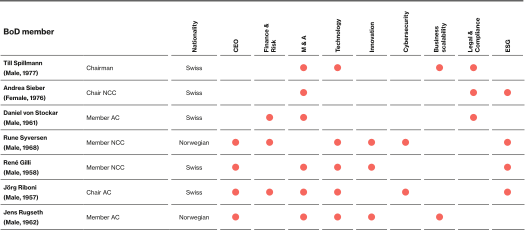
The NCC has updated its strategic skills matrix with a focus on aspects such as Board size, diversity, independence, nationality, committee representation, and future skills needed to better understand the priorities for future Board recruitments. The Swiss CO establishes a target that there be a representation of at least 30% of each gender on the BoD. This target has not been attained so far, partly owing to the enlargement of the BoD with the acquisition of the Crayon Group and the admission of two Crayon Board members.
The strategic skills matrix reflecting the BoD composition as of December 2025 is as follows:
Board of Directors’ performance assessment
The BoD, in collaboration with the NCC, has carried out periodic evaluations of the BoD’s and the BoD committees’ performance as well as the work of the Chair. In 2025, the assessment was focused on ESG related competences of BoD members and the next general performance assessment scheduled for 2026. The Board’s commitment to an open, transparent, and critical boardroom culture forms the basis for this annual review of its own performance and effectiveness.
The purpose of the assessment is to review the BoD’s and the committees’ composition, organization, and processes, the BoD’s responsibilities governed by the OrgR, and the Committee Charters. In addition, the committees assess their performance and evaluate their achievements based on predetermined goals. The outcome of the evaluation feeds into the BoD’s succession planning as described in the section “Board of Directors’ skill and experience assessment.”
Board of Directors’ training and education
Education is an important priority for SoftwareOne’s BoD. Newly elected BoD members attend an onboarding program tailored to their functions to gain a sound understanding of SoftwareOne’s organization, business, culture, and environment. In addition to the induction program for new members, all Board members attend refresher programs to update and enhance their knowledge of emerging business trends, risks, and the legal framework. The BoD members also received training on prevention of bribery risks as well as compliance with applicable capital markets rules. The training and education framework is designed to contribute to building a strong and effective culture on the BoD, which is an important pillar of its effectiveness.
Interaction of the Board of Directors with the Executive Board
In accordance with Art. 16 of the AoI and Art. 11.2 of the OrgR, the BoD has delegated the operational management of SoftwareOne and the Group entirely to the EB, within the limits permitted by and subject to the powers and duties remaining with the BoD pursuant to the OrgR.
The EB supports the BoD in the performance of its duties and prepares proposals for consideration and decision-making by the BoD. These proposals are related to the following key Group responsibilities: long-term strategy, business plan resilience, organizational structure, accounting principles, finance, capital markets, risk management including insurance, HR matters, corporate social responsibility, share capital, and financing in general, as well as important strategic transactions. BoD resolutions provide appropriate feedback and unambiguous instructions to the Co-CEOs and other members of management.
The BoD supervises and monitors the performance of the EB through reporting and controlling processes. The Co-CEOs and other EB members regularly provide reports and updates to the BoD. These include information on key performance indicators and other relevant financial data, on current and forward-looking risks, and on developments in important markets, the industry, and material events. The Chair of the BoD regularly meets with the Co-CEOs and other EB members outside of regular BoD meetings, and individual BoD members meet individual EB members with whom they are paired under a structured mentoring program. SoftwareOne has an information and financial reporting system, with annual targets reviewed by the EB in detail and approved by the BoD. SoftwareOne has adopted and implemented a formal approach to risk management and control, described in more detail in the section Audit Committee.
SoftwareOne has purchased and maintains a directors and officers liability insurance on behalf of the members of the Board of Directors and company officers. The insurance includes controlled subsidiaries and is issued by a reputable insurer.
The BoD remains entitled to resolve any matters that are not delegated to or reserved for the Annual General Meeting of shareholders or another executive body of the company by law, the AoI, or the OrgR. Furthermore, the BoD may at any time, on a case-by-case basis, or according to a general reservation of powers provided in the OrgR, intervene in the tasks and powers of an executive body and resolve the issue in question itself.
Audit Committee
Key responsibilities and duties
The AC comprises at least three members of the BoD. As at December 31, 2025, the AC comprised three members. The members of the AC and the Chair are appointed annually by the BoD, which aims to appoint non-executive and independent members (as defined in the Swiss Code) of the BoD. The Chair of the AC must be an independent BoD member other than the Chair of the BoD. The members, including the Chair of the AC, should be experienced in financial and accounting matters. The term of office of AC members ends at the conclusion of the next Annual General Meeting. Re-appointments are possible. The AC meets whenever business requires, and at least four times per year.
The AC supports the BoD in the fulfilment of its duties as per Art. 716a CO in the areas of financial controls (supervision of internal and external auditing, monitoring of financial reporting), supervision of persons entrusted with the management of the Group (assessing the effectiveness of internal and external control systems), risk management processes, and oversight of key non-financial processes (corporate social responsibility and compliance). Its duties and responsibilities are set out in the AC Charter.
Audit Committee activities in the reporting period
In 2025, the AC held twelve mostly hybrid meetings, with some members and participants attending physically or by video conference. The meetings were held in January, February, March, May, June, July, August, October, November, and December, and the average length was approximately 2:50 hours. The committee focused on several key areas, including but not limited to the activities described below. Specifically, the AC:
- Completed a strategic review;
- Discussed the coverage of the Group audit;
- Reviewed the risk map, including financing and forex risks, and internal and external audit plans;
- Reviewed the tax strategy and effective tax rate;
- Reviewed of treasury strategy, funding and capital structure;
- Reviewed updates on IT roadmaps and IT security;
- Reviewed regular updates on legal and compliance matters;
- Reviewed the draft 2024 Annual Report and the draft 2025 Half-Year Report as well as the two draft quarterly trading updates in relation to the first and third quarter of 2025, respectively;
- Reviewed internal policies.
The AC sets the audit plan for a period of several years as well as the scope of the internal and external audits and approves the guidelines for the work of the Internal Audit department and the company’s Compliance department. It reviews and approves the internal and external audit plans, changes to the plans, activities, scope, and budget as well as accounting policies. The AC approves the fees for the external auditors and appraises the appropriateness of risk-based estimates and judgments as well as the methods used to account for unusual transactions. Furthermore, the AC defines the organizational structure of the Internal Audit function and sets and reviews the qualifications of the Internal Audit department as deemed appropriate. The AC may hold meetings with representatives of the internal and external auditors without the presence of management. Such meetings must take place at least once per year with the external auditors. In 2025, the AC held eight of its twelve meetings with the internal auditors, and eight meetings with the external auditors.
It is the AC’s responsibility to assess both the performance of the internal and external auditors and their cooperation with one another.
In consultation with management and the external and internal auditors, the AC discusses the integrity of SoftwareOne’s financial reporting processes, management controls, compliance management, and the functionality of internal controls, and reviews significant financial risk exposures and the steps taken by management to monitor, control, and report such exposures.
The Head of Internal Audit and the Chief Legal Officer have a direct reporting line to the AC in case of significant compliance issues with the potential for major financial or reputational damage, including issues concerning management. The AC has direct access to the Internal Audit department and may obtain all the information it requires from the department, including direct access to employees. The AC ensures that it receives regular information from both the internal and the external auditors. The AC has higher-level oversight of internal and external auditing.
Interactions with the EB
The AC regularly invites the Co-CEOs, the CFO, and other members of the EB or, subject to prior notification of the responsible member of the EB, members of the company’s management or other key employees to its meetings, as deemed desirable or appropriate. In addition, other executive officers/employees of the company or its subsidiaries participate in meetings of the AC on a consultative basis if invited by the AC Chair or, in their absence, a member of the AC. Third parties may also be invited to participate in meetings of the AC on a consultative basis. In 2025, SoftwareOne’s CFO participated in all twelve AC meetings.
Risk management
ESRS 2 GOV-2 26 (c)
The BoD is responsible for overseeing SoftwareOne’s risk management and internal control systems and has mandated the AC with this task. The AC monitors the strategic risk management processes and reviews the risk management framework against the company’s risk management strategy, providing recommendations and appropriate mitigations. It further assesses the robustness of the company’s risk management policies and processes related to the risk management strategy. These systems provide appropriate security against significant inaccuracies and material losses.
Risks are identified using a variety of methods, including a formal enterprise risk assessment. This assessment considers whether key (emerging) risks that could impact the achievement of SoftwareOne’s strategic objectives are being appropriately managed.
The assessment results are included in a risk register, which considers the gross risk (without mitigation measures) and the net risks (with and without mitigation measures including controls). An internal controls system is in place for financial risks, in which control owners attest to the effectiveness of their controls and provide supporting evidence. The updated risk register is discussed and reviewed with the AC at least once per year. The company applies a three-line defense model to ensure that effective risk management is in place.
First line:
- Leaders and employees who are responsible for identifying and managing risk as part of their accountability to achieve objectives.
- Effective internal controls on day-to-day processes.
Second line:
- Functions overseeing or specializing in compliance or risk management.
- Policies, frameworks, tools, techniques, and other support to enable effective risk and compliance management.
Third line:
- Internal audit function and the external auditors providing independent and objective assurances, and consulting services.
- Reports to AC with a risk-based approach, evaluating the design and operating effectiveness of policies, procedures, and controls.
- Scope: enterprise-wide, including finance, operations, and technology.
On the basis of its risk management oversight activities, the AC makes proposals to the BoD regarding the company’s corporate governance, compliance, and corporate responsibility framework. The AC also assesses the effectiveness of the internal control system in relation to key financial processes, formulates a view on the situation concerning compliance with applicable standards and guidelines, and develops these further.
The Group risk management function is embedded throughout the business and ensures an integrated approach to managing current and emerging threats. Risk management plays a key role in business strategy and planning discussions. At SoftwareOne, the Group risk management function falls within the remit of the CFO.
Strategic risk management has identified key areas of risk that are constantly monitored by Group risk management and the AC. The following key strategic risk categories have been identified:
Strategic business risks, e.g.:
- Integration;
- Significant losses of the value chain in software & cloud;
- Slow innovation;
- Microsoft’s CSP transition and direct-to-customer shift;
- ESG risks.
Operational risks, e.g.:
- IT security, including cyber and data;
- IT applications;
- Customer security breaches in cloud consumption;
- Integration and synergy execution.
Financial risks, e.g.:
- Unhedged market risk;
- Accounts receivable risk;
- Currency fluctuation risk;
- Net working capital and liquidity risk;
- Breach of bank covenants;
- Transfer pricing;
- Tax risks;
- Performance measurement and controlling.
Legal and compliance risks, e.g.:
- Non-conformity, illegal acts, internal or external fraud;
- Reputational risk;
- Professional liabilities with service business;
- Non-compliance with laws and regulations, including stock market regulations;
- Internal or external fraud.
Risk management is carried out by line management, controlled by the CFO in accordance with policies approved by the BoD, and reviewed and supervised by the AC. Key risks are identified, evaluated, and managed in close cooperation with the Group’s operating units. The BoD provides written principles for overall risk management, as well as written policies covering specific areas within the risk categories.
The company’s risk management system covers the entire application management process for all local and global IT systems, and ensures the regular monitoring and updating of its IT systems and processes to ensure reliability, business continuity, and performance.
A key non-financial risk for SoftwareOne is IT security, hence the assessment of performance against an IT security framework is an important ongoing task for Internal Audit. To ensure that the appropriate specialists in Internal Audit can conduct their assessments according to the highest and latest industry standards, SoftwareOne provides the relevant training and resources required by Internal Audit.
SoftwareOne and its subsidiaries hold numerous ISO/IEC certifications, including ISO 9001:2015 for quality management systems, ISO 14001:2015 for environmental management systems, ISO/IEC 27001:2013 for information security management, ISO/IEC 27701:2019 for privacy information management systems, ISO 22301:2019 for security and resilience for Turkey, and ISO/IEC 27017:2015 for Brazil and India on information security controls for cloud services and ISO 37001 for Brazil and Turkey. The list of certifications is available at ISO Certifications - SoftwareOne.
Quality audits are an integral part of SoftwareOne’s quality management system and cover the control of established processes to fulfil all required regulatory industry standards.
The AC periodically monitors SoftwareOne’s risk assessment and assesses the proposed risk mitigation measures proposed by the EB on at least an annual basis.
Nomination and Compensation Committee
NCC key responsibilities and duties
As at December 31, 2025, the NCC comprised three members. The members of the NCC are each elected annually and individually at the shareholders’ meeting. Their term of office ends at the conclusion of the next ordinary shareholders’ meeting, and re-election is possible. The Chair of the NCC is appointed by the BoD. The Chair of the NCC is always an independent member of the BoD, and there is an independent majority on the NCC (with the casting vote of the Chair).
If there are vacancies on the NCC, the BoD may appoint substitute members from its members for a term of office extending until the conclusion of the next ordinary shareholders’ meeting. The NCC meets whenever business requires, and at least three times per year.
The NCC has the powers and duties of a compensation committee as defined under Swiss law as well as the powers and duties as provided in Art. 15 para. 5 of the AoI and the NCC Charter. The overall responsibility for the duties and powers assigned to the NCC remains with the BoD. The NCC regularly reports to the BoD on its activities and submits the necessary proposals. Details of the compensation policies and principles can be found in the Compensation report.
NCC activities in the reporting period
The NCC held nine meetings in 2025, all by video conference. The average length of these calls was approximately 1:50 hours. In addition, four extraordinary meetings were further held in connection with EB-level selection processes. The committee focused on several key areas, including:
- Providing guidance on composition and succession planning of the BoD;
- Crayon Group integration;
- Appointment of a new Co-CEO and CFO;
- A compensation framework including compensation levels and benchmark analysis for the EB and BoD;
- Preparing compensation decisions, including the setting of short-term incentive and long-term incentive targets, short-term incentive pay-outs, long-term incentive grants, and salaries for EB members;
- Review of the Salary Round Budget 2026;
- Diversity review;
- External mandates review.
The NCC’s work on compensation-related matters is described in detail in the Compensation report.
NCC interactions
The NCC regularly invites both Co-CEOs to its meetings and may invite other members of the EB or, subject to prior notification of the responsible member of the EB, members of the company’s management, as it deems desirable and appropriate for the proper fulfilment of its tasks.
The Co-CEOs or other members of the EB may not be present when the NCC reviews the compensation or other aspects of the employment of the relevant person. The Chair of the BoD or the NCC Chair is not present when the NCC reviews their compensation. In 2025, either one or both Co-CEOs participated in seven of the nine meetings of the NCC. The NCC regularly consults the Chief Human Resources Officer to develop and recommend appropriate actions to the BoD.
In the process of evaluating SoftwareOne’s performance against predetermined compensation-relevant performance metrics, the NCC generally consults with the Chair of the AC annually to obtain information on the relevant metrics.
To further develop the compensation system, in particular the reviews of the short- and long-term incentive schemes, the NCC worked together with the external service provider HCM Hostettler & Company (HCM). This was the only business relationship and mandate of SoftwareOne with HCM.