Financial and business review
Market environment
In 2025, geopolitical uncertainty continued to influence markets, though easing inflation and improving business confidence supported stable economic activity. Across the IT sector, digital transformation remained a priority, driving sustained demand for cloud migration, cybersecurity, data analytics, and artificial intelligence. Organizations focused on optimizing existing technology investments, while the rapid pace of innovation reinforced the importance of trusted partners with deep technical and advisory capabilities.
The Value‑Added Reseller (VAR) and IT services market delivered moderate but steady growth, supported by the continued shift toward hybrid and multi‑cloud environments. Demand for software lifecycle management, managed services, and consumption‑based models continued to increase. Pricing trends reflected ongoing vendor adjustments and the broader move toward subscription‑based licensing. Despite cost discipline across many industries, IT spending remained comparatively resilient, with customers prioritizing initiatives linked to cost efficiency, security, and productivity.
These dynamics support the long‑term attractiveness of the global software and services spending market, which is projected to reach USD 4.45 trillion in 2029, representing a 2024–2029 CAGR of 10.28%. Software is expected to grow at a 13.3% CAGR to USD 2.08 trillion, while services are forecast to reach USD 2.37 trillion, growing at 8% annually.
Market size (USDbn), CAGR (%)
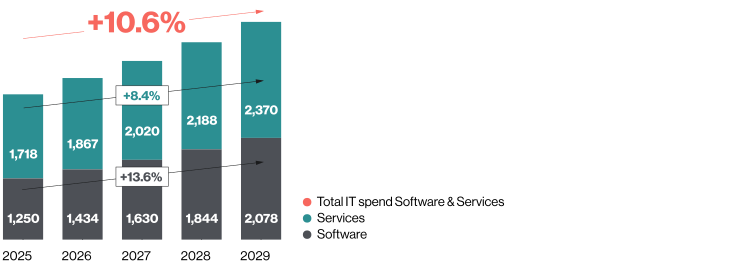
Source: Gartner forecasts as of Q4 2025Figures reflect enterprise software and IT services only; devices, data center systems, and communications services are excluded
The market remains highly diverse and fragmented, offering meaningful opportunity for scaled players with comprehensive capabilities. The combination of SoftwareOne and Crayon positions the company as a global leader in this environment, with the breadth, expertise, and reach required to capture structural growth opportunities in an evolving digital economy.
Financial summary
The financial results of SoftwareOne are reported in accordance with IFRS Accounting Standards. In addition, the company presents an adjusted profit and loss statement, which excludes items and related tax impacts that are not indicative of the underlying performance of the business nor its future growth potential. This set of data reflects the company’s internal approach to analyzing the results. At the end of this section, SoftwareOne provides a reconciliation from IFRS-reported to adjusted profit and loss statement, an overview of adjustments made and definitions of non-IFRS financial measures.
Consolidated IFRS figures
Key figures Group
CHFm | FY 2025 | FY 2024 | % Δ | Q4 2025 | Q4 2024 | % Δ |
Gross sales | 14,180.3 | 11,375.4 | 24.7% | - | - | - |
Total revenue | 1,243.4 | 1,015.4 | 22.5% | 413.7 | 251.2 | 64.7% |
OPEX | -1,035.8 | –899.4 | 15.2% | –333.1 | –229.8 | 44.9% |
Reported EBITDA | 207.6 | 116.0 | 79.0% | 80.6 | 21.4 | >100% |
Reported EBITDA margin (% revenue) | 16.7% | 11.4% | 5.3pp | 19.5% | 8.5% | 11.0pp |
Reported net profit | 1.4 | –1.6 | >100% | - | - | - |
Reported EPS (diluted) | 0.00 | –0.01 | - | - | - | - |
Adj. EBITDA | 277.0 | 223.4 | 24.0% | 97.1 | 62.3 | 55.7% |
Adj. EBITDA margin (% revenue) | 22.2% | 22.0% | 0.2pp | 23.4% | 24.9% | (1.5)pp |
Adj. net profit | 89.6 | 73.0 | 22.8% | - | - | - |
Adj. EPS (diluted), in CHF | 0.48 | 0.47 | 2.1% | - | - | - |
DPS, in CHF | 0.15 | 0.30 | - | - | - | - |
Number of shares | 221m | 156m | - | - | - | - |
Net cash from operating activities | 268.6 | 34.7 | >100% | - | - | - |
Net debt/(cash) | 369.3 | –9.8 | - | - | - | - |
Net working capital (after factoring) | –564.4 | –152.8 | - | - | - | - |
Net debt / Adj. EBITDA | 1.3x | - | - | - | - | - |
Headcount (FTEs at end of period) | 12,712 | 9,199 | 38.2% | - | - | - |
Group revenue increased 22.5% to CHF 1,243.4 million in 2025, reflecting the acquisition of Crayon closed on July 2, 2025. On an organic basis, excluding Crayon, revenue declined 1.3% year-on-year in constant currency in 2025.
The strengthening of the Swiss franc against key currencies led to a negative FX translation impact of 4.7 percentage points on Group revenue in 2025.
Reported EBITDA rose to CHF 207.6 million for the full year, reflecting a margin of 16.7% - a significant improvement of 5.3 percentage points compared to the prior year, driven by the benefits of the previously initiated cost reduction program, synergy impact and continuous cost control, while also reflecting significantly lower restructuring costs compared to the prior year.
Adjusted EBITDA ended at CHF 277.0 million, with a margin of 22.2%.
Net profit for the period was CHF 1.4 million in 2025, compared to a loss of CHF 1.6 million in the prior year.
Net profit includes impairments of CHF 17.8 million related to office closures and intangible assets, and including CHF 8.0 million goodwill impairment in LATAM. During 2025, financial performance in LATAM was significantly below expectations. Management assessed this as an impairment indicator and therefore performed an updated impairment test as of December 31, 2025. As part of a portfolio review, the company has decided to exit four non-strategic markets in the region to support improved future performance. Adjusted net profit for the period was CHF 89.6 million in 2025, compared to CHF 73.0 million in 2024.
Like-for-like combined figures, unless otherwise noted
Key figures Group
CHFm | FY 2025 | FY 2024 | % Δ | % Δ (CCY) | Q4 2025 | Q4 2024 | % Δ | % Δ (CCY) |
Software & Cloud Direct | 671.3 | 732.0 | –8.3% | –5.0% | 187.5 | 177.1 | 5.9% | 10.1% |
Software & Cloud Channel | 120.4 | 106.9 | 12.7% | 18.7% | 30.0 | 25.9 | 16.0% | 20.6% |
Software & Cloud Services | 726.4 | 711.5 | 2.1% | 5.3% | 197.4 | 185.3 | 6.5% | 10.6% |
Total revenue | 1,518.2 | 1,550.4 | –2.1% | 1.4% | 414.9 | 388.3 | 6.9% | 11.0% |
OPEX | -1,201.2 | -1,234.2 | –2.7% | 1.0% | –317.8 | –300.8 | 5.7% | 11.4% |
Adj. EBITDA | 317.0 | 316.2 | 0.3% | 2.8% | 97.1 | 87.5 | 11.0% | 12.5% |
Adj. EBITDA margin (% revenue) | 20.9% | 20.4% | 0.5pp | - | 23.4% | 22.5% | 0.9pp | - |
Reported EBITDA | 242.7 | 202.9 | 19.6% | - | 80.6 | 43.7 | 84.4% | - |
Reported EBITDA margin (% revenue) | 16.0% | 13.1% | 2.9pp | - | 19.5% | 11.2% | 8.3pp | - |
Group revenue increased 1.4% YoY in ccy to CHF 1,518.2 million in 2025, ahead of the flat revenue growth guidance. Growth was driven by continued strong performance in Channel and Services, while Direct was impacted by Microsoft incentive changes, which gradually subsided towards the end of the year. In reported currency, 2025 revenue declined 2.1% YoY. This was primarily driven by the strengthening of the Swiss franc against key currencies, including the US dollar, Indian rupee, and Australian dollar.
In Q4 2025, performance strengthened, with Group revenue growth accelerating to 11.0% YoY ccy reaching CHF 414.9 million. All business lines accelerated during the quarter, with Direct returning to double-digit growth as Microsoft incentive headwinds subsided, while Channel increased 20.6% YoY ccy and Services grew 10.6% YoY ccy, driven by strong growth in AWS cloud services and ITAM services.
Full-year operating expenses grew 1.0% ccy compared to 2024 and were down 2.7% in reported currency. During 2025, the company realized benefits from the cost saving program and synergies of around CHF 90 million, which were partly offset by performance-related compensation, reinvestments in sales and delivery capabilities, and higher third-party delivery costs resulting in a broadly stable cost development.
Reported EBITDA ended at CHF 242.7 million in 2025, up 19.6% compared to the prior year. The reported EBITDA margin improved by 2.9 percentage points to 16.0%, driven by the cost reduction program initiated previously and completed in Q1 2025, and continued strict cost control.
Adjusted EBITDA for 2025 was CHF 317.0 million, up 2.8% YoY ccy, while the margin was up by 0.5 percentage points.
Total EBITDA adjustments amounted to CHF 74.3 million in 2025, of which CHF 51.4 million were related to the Crayon acquisition. Remaining adjustments related to restructuring and other costs of CHF 22.9 million, well within the ambition to reduce these adjustments below CHF 30 million during 2025.
Revenue by region
Following the acquisition of Crayon at the beginning of July, operating segments have been reassessed. Given Crayon’s significant presence in the Nordics and the CEE, the rEMEA region has been restructured into three new operating regions: Nordics, WEMEA, and CEE.
CHFm | FY 2025 | FY 2024 | % Δ (CCY) | Q4 2025 | Q4 2024 | % Δ (CCY) |
DACH | 346.7 | 342.4 | 2.8% | 97.0 | 84.8 | 15.4% |
WEMEA | 317.2 | 315.0 | 3.3% | 89.8 | 82.2 | 12.2% |
APAC | 267.6 | 257.1 | 11.4% | 68.0 | 65.3 | 14.4% |
NORDICS | 211.9 | 213.6 | 0.7% | 59.6 | 57.3 | 3.9% |
NORAM | 175.3 | 212.7 | –12.6% | 40.4 | 46.6 | –4.7% |
LATAM | 89.8 | 100.3 | –4.4% | 24.8 | 25.4 | –1.7% |
CEE | 77.9 | 71.2 | 14.0% | 24.1 | 18.7 | 32.7% |
Group, FX and Other | 31.8 | 38.2 | - | 11.2 | 8.0 | - |
Group revenue | 1,518.2 | 1,550.4 | 1.4% | 414.9 | 388.3 | 11.0% |
DACH revenue grew 2.8% YoY ccy to CHF 346.7 million in 2025. While headwinds from Microsoft incentive changes on enterprise agreements persisted during the year, this was offset by successful transition from enterprise agreements to CSP, as well as strong multivendor and public sector growth. In Q4 2025, revenue grew 15.4% YoY ccy, supported by the same drivers as well as reflecting a materially easing impact from Microsoft incentive changes.
Revenue in WEMEA increased 3.3% YoY ccy to CHF 317.2 million, driven by strong double-digit growth in multivendor sales and Services. Full-year growth was partly offset by changes in Microsoft incentives. In Q4 2025, revenue grew 12.2% YoY in constant currency.
APAC grew 11.4% YoY ccy to CHF 267.6 million in 2025, driven by strong results across the region, with India performing particularly well. The largest contributor to growth came from Services business driven by strong demand within data & AI and cloud services. Channel business grew above 20% YoY ccy. Direct business ended flat following Microsoft incentive changes on enterprise agreements. In Q4 2025, revenue grew 14.4% YoY ccy. During Q1 2026, the company received a commitment from a public sector customer in the Philippines for a payment of USD 37 million in relation to previously outstanding receivables, with the majority already received.
Revenue in the Nordics grew 0.7% YoY ccy to CHF 211.9 million. During the year growth in the Direct business was positive and accelerated to double-digit in the fourth quarter as the impact from Microsoft incentives changes subsided. Full-year growth performance was partially impacted by softer demand in the Service business which remained stable YoY. In Q4 2025 revenue grew 3.9% YoY ccy.
NORAM declined 12.6% YoY ccy to CHF 175.3 million in 2025 as a result of continued GTM-related sales execution issues and impact from Microsoft incentive changes on enterprise agreements. In Q4 2025, revenue declined by 4.7% YoY ccy driven by persistent internal sales execution weakness. The previously initiated turnaround measures are gradually stabilizing performance, and internal sales metrics show sequential improvement, supporting a gradual recovery in 2026.
LATAM declined 4.4% YoY ccy to CHF 89.8 million in 2025, driven in particular by weakness in the Direct business. This was partly offset by strong growth in the Services business with high demand for project work related to Google, SAP and cyber security. In Q4 2025, revenue declined 1.7% YoY ccy driven by negative performance in the Direct business. As part of a portfolio review and to support improved future performance, the company has decided to exit 4 non-strategic and non-commercial countries in the region.
CEE grew revenue with 14.0% YoY ccy to CHF 77.9 million in 2025. Performance was driven by strong double-digit growth across both the Direct business and the Service business. In Q4 2025, revenue grew 32.7% YoY in constant currency.
Performance by segment
Key figures – Software & Cloud Direct
CHFm | FY 2025 | FY 2024 | % Δ (CCY) | Q4 2025 | Q4 2024 | % Δ (CCY) |
Revenue | 671.3 | 732.0 | –5.0% | 187.5 | 177.1 | 10.1% |
Adj. EBITDA | 333.1 | 354.5 | –2.9% | 100.2 | 93.0 | 12.1% |
Adj. EBITDA margin (% of revenue) | 49.6% | 48.4% | 1.2pp | 53.4% | 52.5% | 0.9pp |
Revenue in Software & Cloud Direct declined 5.0% YoY ccy to CHF 671.3 million in 2025. While multivendor growth was strong, the performance reflects the impact from changed incentives for enterprise agreements relating to the Microsoft transactional business. Impacts from Microsoft incentive changes subsided during the second half of the year and the performance in Q4 2025 was strong with revenue growth of 10.1% YoY ccy. Q4 2025 growth was primarily driven by an accelerated transition from enterprise agreements to CSP as well as continued multivendor growth.
Adjusted EBITDA was CHF 333.1 million in 2025, with margin ending at 49.6%, up from 48.4% in the prior year.
Key figures – Software & Cloud Channel
CHFm | FY 2025 | FY 2024 | % Δ (CCY) | Q4 2025 | Q4 2024 | % Δ (CCY) |
Revenue | 120.4 | 106.9 | 18.7% | 30.0 | 25.9 | 20.6% |
Adj. EBITDA | 57.8 | 51.7 | 17.7% | 12.2 | 10.7 | 14.0% |
Adj. EBITDA margin (% of revenue) | 48.0% | 48.4% | -0.4pp | 40.7% | 41.3% | -0.5pp |
Software & Cloud Channel delivered revenue growth of 18.7% YoY ccy to CHF 120.4 million in 2025. Performance was driven mainly by APAC, with a strong contribution from NORAM and DACH as well. Revenue grew 20.6% YoY ccy in Q4 2025 driven by continued strong performance in APAC.
Adjusted EBITDA was CHF 57.8 million in 2025, with margin ending at 48.0%, at the same level as prior year.
Key figures – Software & Cloud Services
CHFm | FY 2025 | FY 2024 | % Δ (CCY) | Q4 2025 | Q4 2024 | % Δ (CCY) |
Revenue | 726.4 | 711.5 | 5.3% | 197.4 | 185.3 | 10.6% |
Adj. EBITDA | 36.2 | 8.1 | >100% | 16.3 | 3.3 | >100% |
Adj. EBITDA margin (% of revenue) | 5.0% | 1.1% | 3.9pp | 8.2% | 1.8% | 6.5pp |
Software & Cloud Services delivered revenue growth of 5.3% YoY ccy to CHF 726.4 million in 2025. The performance was driven by strong growth in cybersecurity, AWS cloud services, multivendor support services, and local portfolio managed services. In Q4 2025, the Services business accelerated growth ending at 10.6% YoY ccy mainly driven by strong growth in AWS clouds services and ITAM services.
Adjusted EBITDA was CHF 36.2 million in 2025, with margin ending at 5.0% up from 1.1% in the prior year.
Integration progressing from structural alignment to execution and value realization
Integration continues to progress according to plan and has now moved firmly into the execution phase. Combined regional and country leadership teams are fully operational, and the new operating model for customer-facing functions is being implemented across key markets. Legal entity simplification and system harmonization are advancing, with early benefits already visible in pipeline development and cross-selling activity.
Run-rate cost synergies increased to CHF 43 million by year-end 2025, reflecting continued delivery across overhead optimization and organizational alignment initiatives. As of mid-March 2026, total realized cost synergies amounted to CHF 64 million.
The company remains well on track towards its synergy target and now expect to achieve CHF 100 million by the end of 2026.
Beyond cost synergies, commercial integration is gaining traction. Joint go-to-market initiatives, coordinated vendor engagement and cross-selling across IT cost management, software & cloud, cloud services and data & AI are contributing to an expanding combined pipeline. The focus in 2026 will shift increasingly towards the full value realization, including completion of system integration, global process alignment, and execution of the unified vendor and Channel strategy.
Outlook for the combined company
SoftwareOne provides full-year 2026 guidance as follows:
- Mid-single digit YoY ccy revenue growth on a combined like-for-like basis
- Adjusted EBITDA margin above 23% on a combined like-for-like basis
- Dividend pay-out ratio of 30–50% of the adjusted profit for the year
In terms of cost synergies, SoftwareOne now expects to deliver CHF 100 million of run-rate synergies by the end of 2026, reflecting confidence in reaching the upper end of the previously communicated range.
2026 growth expectations reflect the structural shift from traditional licensing models towards cloud-based subscription and consumption-driven solutions, combined with broader multi-vendor expansion. Growth in Services is expected to be driven by customers’ increasing need to optimize complex cloud environments, manage software estates more efficiently, and unlock value from data & AI.
Use of treasury shares
Regarding 4'398’263 registered shares repurchased from the market in the share buyback program completed on November 22, 2024, the company has decided to not cancel these shares but instead use them for purposes of its own share-based remuneration programs.
Management-defined performance measures
SoftwareOne has defined a set of non-IFRS, or management-defined financial measures, which reflect the company’s internal approach to analyzing its performance and which are also disclosed externally. These measures allow key decision makers at SoftwareOne to manage the company and make investment decisions. The company believes that such measures are also frequently used by external stakeholders such as sell-side research analysts, investors, and other interested parties to evaluate peers in the same industry.
Results overview
Link to full overview of SoftwareOne’s consolidated financial statements
Profit & loss summary
in CHF million Reported | Adjusted | |||||
2025 | 2024 | 2025 | 2024 | % Δ | ||
Revenue | 1,243.4 | 1,015.4 | Adj. revenue | 1,246.8 | 1,017.0 | 22.6% |
Third-party service delivery costs | –53.7 | –40.2 | Third-party service delivery costs | –53.8 | –40.2 | 33.6% |
Personnel expenses | –780.1 | –657.2 | Personnel expenses | –745.6 | –600.0 | 24.3% |
Other operating expenses | –222.4 | –217.0 | Other operating expenses | –190.6 | –168.5 | 13.1% |
Other operating income | 20.4 | 15.0 | Other operating income | 20.2 | 15.1 | 34.3% |
EBITDA1) | 207.6 | 116.0 | Adj. EBITDA1) | 277.0 | 223.4 | 24.0% |
Depreciation, amortization and impairment2) | –123.7 | –72.7 | Adj. depreciation, amortization and impairment2) | –105.7 | –72.6 | 45.5% |
Earnings before net financial items and taxes | 83.9 | 43.3 | Adj. earnings before net financial items and taxes | 171.3 | 150.7 | 13.7% |
Net financial items | –54.4 | –11.4 | Adj. net financial items | –41.3 | –31.1 | 32.7% |
Earnings before income tax | 29.5 | 31.9 | Adj. earnings before income tax | 130.1 | 119.6 | 8.8% |
Income tax expenses | –28.1 | –33.5 | Adj. income tax expenses | –40.4 | –46.7 | –13.4% |
Profit/(loss) for the period | 1.4 | –1.6 | Adj. Profit/(loss) for the period | 89.6 | 73.0 | 22.8% |
EBITDA1) margin (% revenue) | 16.7% | 11.4% | Adj. EBITDA1) margin (% revenue) | 22.2% | 22.0% | 0.2pp |
Earnings per share (diluted), CHF | 0.00 | –0.01 | Adj. earnings per share (diluted), CHF | 0.48 | 0.47 | 2.1% |
1) Earnings before net financial items, taxes, depreciation and amortisation
2) Includes PPA amortization (including impairments, if applicable) of CHF 26.7 million and CHF 14.0 million in 2025 and 2024, respectively
3) Constant currency growth rate calculated on adjusted figures
Adjustments
in CHF million | 2025 | 2024 |
Revenue | 1,243.4 | 1,015.4 |
Adjustment details - Revenue | ||
Revenue recognition adjustment IFRS 15 | 2.8 | –0.6 |
Discontinuation of MTWO vertical | 0.1 | 2.1 |
Crayon integration | 0.4 | - |
Revenue adjustments | 3.3 | 1.6 |
Adj. revenue | 1,246.8 | 1,017.0 |
Earnings before net financial items, taxes, depreciation and amortization | 207.6 | 116.0 |
Adjustment details - Earnings before net financial items, taxes, depreciation and amortization | ||
Revenue recognition adjustment IFRS 15 | 2.7 | –0.5 |
Crayon transaction and integration expenses | 48.3 | - |
Other integration, M&A and earn-out expenses | 3.8 | 13.4 |
Operational excellence and GTM restructuring expenses | 19.2 | 42.4 |
Cost reduction program | - | 24.0 |
Discontinuation of MTWO vertical | 0.3 | 7.4 |
Other non-recurring items | –4.9 | 14.6 |
Impact of additional provision for overdue receivables1) | - | 6.0 |
Total Earnings before net financial items, taxes, depreciation and amortization adjustments | 69.4 | 107.3 |
Adj. Earnings before net financial items, taxes, depreciation and amortization | 277.0 | 223.4 |
Adjustments others | ||
Depreciation and amortization | 10.0 | 0.1 |
Financial result | 13.2 | –19.7 |
LATAM impairment | 8.0 | - |
Tax impact of adjustments | –12.4 | –13.1 |
Total adjustments other | 18.8 | –32.7 |
Total adjustments | 88.2 | 74.6 |
1) Relates to overdue receivables over 180 days outstanding and under legal dispute, with success rate of collection by SoftwareOne taken down to zero
Source: Management view
Net working capital
in CHF million | 2025 | 2024 |
Trade receivables | 3,424.5 | 2,616.0 |
Other receivables | 131.1 | 102.5 |
Prepayments and contract assets | 203.9 | 122.1 |
Trade payables | 3,718.0 | 2,568.5 |
Other payables | 356.2 | 237.2 |
Accrued expenses and contract liabilities | 249.6 | 187.7 |
Net working capital (after Factoring) | –564.4 | –152.8 |
Receivables sold under Factoring1) | 406.4 | 124.3 |
Net working capital (before Factoring) | –158.0 | –28.5 |
1) Includes short-term factoring only, with financing terms of less then one year.
Net debt/(cash)
in CHF million | 2025 | 2024 |
Cash and cash equivalents | 419.1 | 271.3 |
Current financial assets | 0.0 | 62.4 |
Total financial assets | 419.1 | 333.7 |
Bank overdrafts | 0.0 | 4.8 |
Other current financial liabilities | 260.4 | 316.0 |
Other non-current financial liabilities | 527.9 | 3.0 |
Total financial liabilities | 788.4 | 323.9 |
Net debt / (cash) | 369.3 | –9.8 |
Non-IFRS financial measures and Group key performance indicators (KPIs)
The Group presents non-IFRS financial measures used by management to monitor the company’s performance, which may be helpful to external stakeholders in evaluating SoftwareOne’s financial results compared to industry peers. They include the following:
Adjusted EBITDA is defined as the underlying earnings before net financial items, tax, depreciation, and amortization, adjusted for items affecting comparability in operating expenses.
Adjusted EBITDA margin is defined as adjusted EBITDA divided by revenue.
Adjusted profit for the period is defined as the profit/(loss) for the period, adjusted for items impacting comparability in operating expenses and net finance income/(expenses) as well as the related tax impact.
Contribution margin is defined as revenue net of third-party service delivery costs and directly attributable internal delivery costs.
Growth at constant currencies is defined as the change between two periods presented on a constant currency basis for comparability purposes and to assess the Group’s underlying performance. Period profit and loss figures are translated from the subsidiaries’ respective local currencies into Swiss francs at the applicable average exchange rate of the prior-year period. This calculation is based on the underlying management accounts.
Like-for-Like combined figures are based on historical like-for-like financials as if the acquisition of Crayon had been completed on January 1, 2024.
Net debt/(cash) comprises group bank overdrafts, other current and non-current financial liabilities less cash and cash equivalents and current financial assets.
Net working capital is defined as the group’s trade receivables, current other receivables, prepayments and contract assets minus trade payables, current other payables and accrued expenses and contract liabilities.
Exchange rates
The table below shows the development of the Swiss franc, SoftwareOne’s reporting currency, against major currencies. In addition, the charts provide an overview of the currency breakdowns, including currencies which had the biggest impact on revenues and operating expenses during 2025.
CHF to LCY | 2025 | 2024 | % change |
EUR | 1.07 | 1.05 | 1.6% |
USD | 1.21 | 1.14 | 6.4% |
CHF | 1.00 | 1.00 | 0.0% |
NOK | 12.48 | 12.19 | 2.4% |
GBP | 0.91 | 0.89 | 2.8% |
FX exposure
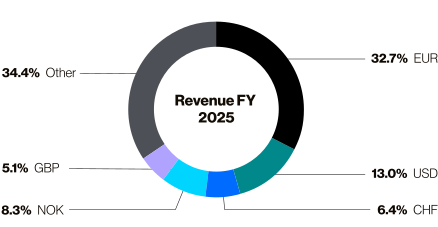
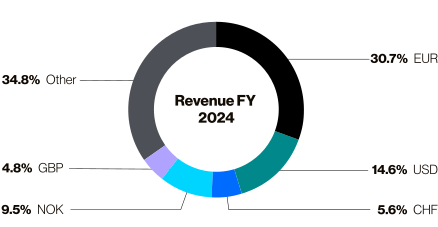
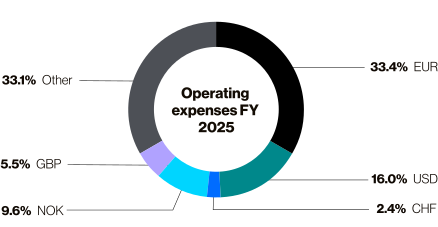
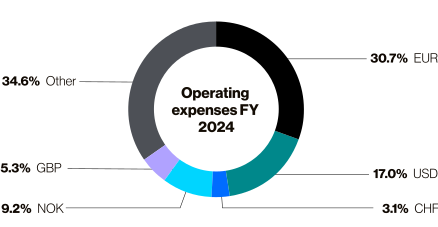
Source: based on management accounts; 2025 and 2024 figures based on like-for-like historical financials as if the acquisition of Crayon had been completed on January 1, 2024.
SoftwareOne share
SoftwareOne aims to create long‑term value for shareholders by delivering on its business plan and maintaining transparent, timely, and accurate communication with the capital markets. The objective of SoftwareOne’s investor relations activities is to support a fair valuation of the Company’s securities by ensuring that the share price reflects its value, risk profile, and growth opportunities. Engagement with investors and analysts is a high priority, with a focus on providing all stakeholders, existing and potential, with simultaneous access to relevant and up‑to‑date information. All investor relations activities are conducted in accordance with applicable rules, regulations, and best‑practice standards. The Group publishes quarterly financial results, accompanied by live earnings presentations held by senior management. All reports and presentations are made available to the broader investor community through the online Results center.
SoftwareOne Holding AG has been listed on the SIX Swiss Exchange since October 25, 2019. Since July 3, 2025, SoftwareOne has had a secondary listing on the Oslo Stock Exchange. For further issuer details, please visit the pages on the website of SIX Swiss Exchange or Oslo Euronext. The share capital of SoftwareOne Holding AG, registered in the commercial register of the canton of Nidwalden as at December 31, 2025, was CHF 2,211,029.53 divided into 221,102,953 fully paid-in registered shares with a nominal value of CHF 0.01 each.
Listing | SIX Swiss Exchange (International Reporting Standard) | Euronext Oslo Børs (International Reporting Standard) |
Ticker | SWON | SWON |
Swiss security number | 49.645.150 | 49.645.150 |
ISIN | CH0496451508 | CH0496451508 |
Trading currency | CHF | NOK |
Nominal value | CHF 0.01 per share | CHF 0.01 per share |
Share performance
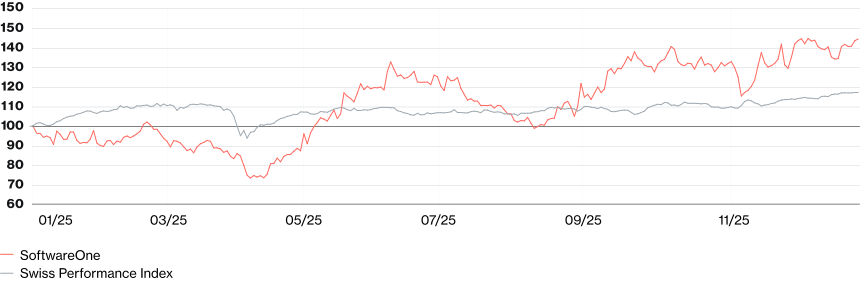
At the end of 2025, the share price stood at CHF 9.05, corresponding to a market capitalization of CHF 1.9 billion. During the year, the share traded between a low of CHF 4.31 in April and a high of CHF 9.35 in November. Overall, the share price increased by 48.4% in 2025.
in %
Analyst coverage
- ABG, Øystein Elton Lodgaard
- Arctic, Halvor Aasen Dybdahl
- Berenberg, Andreas Wolf
- BNP Paribas, Ines Mao
- Cantor Fitzgerland, Edward James
- Citi, Balajee Tirupati
- Deutsche Bank, Nooshin Nejati
- J.P. Morgan, Joseph George
- Kepler Cheuvreux, Florian Treisch
- Morgan Stanley, Adam Wood
- Pareto Securities, Olav Rødevand
- Research Partners AG, Reto Huber
- UBS, Christopher Tong
- ZKB, Christian Bader
Corporate calendar
May 12, 2026
Q1 2026 Trading update
May 22, 2026
Annual General Meeting (AGM)
June 9, 2026
Capital Markets Day (CMD)
August 26, 2026
2026 Half-year results and Half-year report
November 11, 2026
Q3 2026 Trading update
Financial risks
The Group’s activities expose it to a variety of financial risks: market risk (including currency risk, interest rate risk), credit risk, and liquidity risk. The Group’s overall risk management program is focused on mitigating the unpredictability of financial markets and aims to minimize potential adverse effects on the Group’s financial performance. To hedge certain risk exposures, the Group uses derivative financial instruments, which are measured using standardized mathematical models.
Risk management is carried out by Group Treasury under the Global Treasury Policy approved by the Board of Directors (BoD). Group Treasury identifies, evaluates, and hedges financial risks in close cooperation with the Group’s operating entities. The BoD provides written principles for overall risk management, as well as written policies covering specific areas, such as foreign exchange risk, interest rate risk, credit risk, use of derivative financial instruments and non-derivative financial instruments, and investment of excess liquidity.
Market risk
The Group operates internationally and is exposed to foreign exchange risk arising from various currency exposures. Foreign exchange risk arises from future commercial transactions, recognized assets and liabilities, and net investments in foreign operations.
The Group hedges its foreign exchange risk exposure of recognized assets and liabilities and future commercial transactions with derivative contracts.
Interest rate risk
The Group’s interest-bearing instruments with variable interest are cash, bank overdrafts, bank loans, a multiple-currency revolving credit facility and a term loan facility. An interest rate risk exists due to changes in market interest rates. The Group has managed the risk of changes in the interest rates on the basis of limits using interest rate derivatives as part of the defined risk strategy. The underlying transactions are designated as cash flow hedges. They are expected to affect profit and loss within the next twelve and 43 months, respectively. At inception of a hedge relationship, the Group designates and documents the hedge relationship to apply hedge accounting. The hedge relationship includes the hedging instrument, the hedged item, and the nature of the risk being hedged. The hedges are expected to be highly effective.
Credit risk
Group Credit & Collection is responsible for managing and analyzing the credit risk for all new clients before standard payment and delivery terms and conditions are offered. Credit risk arises from cash and cash equivalents, derivative financial instruments, and deposits with banks and financial institutions, as well as credit exposures to end customers, including outstanding receivables and contract assets. Risk control assesses the credit quality of the end customers, considering their financial position, past experience and other factors. No collateral is required. Individual risk limits are set based on internal or external ratings in accordance with guidelines set by the BoD. The utilization of credit limits is regularly monitored.
Liquidity risk
Short-term cash flow forecasting is performed in the operating entities of the Group and aggregated by Group Treasury. Group Treasury monitors rolling forecasts of the Group’s liquidity requirements to ensure it has sufficient cash to meet operational needs while always maintaining sufficient headroom on its undrawn borrowing facilities (for further details see below). Mid-term cash planning is performed by Group Controlling.
Detailed quantitative disclosures are provided in Financial risk management.
Corporate governance
A full corporate governance statement is provided in the Corporate governance report. The Board of Directors (BoD) confirms that governance arrangements are appropriate for the company’s operations.
Organization and working environment
SoftwareOne values its employees and strives to create a safe and rewarding work environment for them. Our network of local human resources (HR) representatives, led by the Chief Human Resources Officer, develops, and implements policies and strategies to recruit, select, and engage employees. Our Group-wide people and culture strategy is updated annually, enabling the HR function to support employees and the organization. Responsibility for employee health and safety at SoftwareOne is shared between the Human Resources and Facilities Management teams in our offices around the world. Sound safety and health practices are integral to our operations, and we comply with all local workplace safety regulations. We had no work-related fatalities or injuries in 2025, and the rate of absence from work due to sickness in SoftwareOne was 1.6%1).
1)Calculated as (Total days of absence due to sickness / Total scheduled working days) × 100. Please note that due to system limitations, this metric reflects only those legacy SoftwareOne employees in 2025 (excluding Crayon) who have already been migrated to the HRIS for leave and absence tracking. Process improvements are underway to ensure more representative figures of the combined company in future.