Sustainability governance
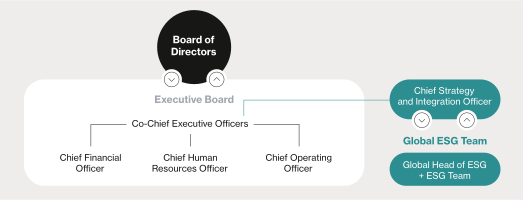
An overview of our sustainability governance model in 2025 is illustrated below:
Board of Directors
Board of Directors composition and diversity
SoftwareOne’s Board of Directors (BoD) comprises seven members, all of whom are elected by shareholders. No BoD members are elected by employees (i.e., there are no employee representatives). All seven BoD members are non-executive.
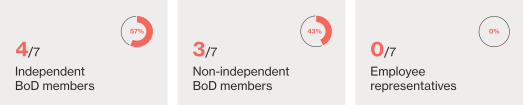
In 2025, one out of the seven BoD members was a woman (14%). The age of BoD members was diverse, ranging from 48 years old to 68 years old, with an average age of 59 years. The seven BoD members together represented two different nationalities, and their educational backgrounds were in law, economics, and business administration.
Board ESG competencies and access to ESG expertise
BoD members have ESG experience through executive and BoD positions in other companies. In summary, the BoD’s collective ESG competencies span ESG reporting and limited assurance and governance or business conduct topics (e.g., BoD structure and independence, risk management, compliance, executive remuneration). The BoD’s ESG competencies are therefore broadly aligned with SoftwareOne’s material impacts, risks, and opportunities described in the Double materiality assessment section in ESRS 2.
To further supplement the BoD’s knowledge in areas related to our material impacts, risks, and opportunities and beyond, the BoD has access to internal ESG expertise in the form of the Global ESG Team as well as other corporate functions and subject matter experts. External consultants may also be conferred with at the discretion of the BoD.
We conducted internal training in 2025 for our BoD on business conduct matters focusing on the issues of insider trading prevention and anti-corruption. The training was led by our Chief Legal Officer. In addition, some BoD members have historically previously completed external ESG-related training courses independently.
Each year, the BoD evaluates its qualifications, experience and performance, presenting this evaluation to the Nomination and Compensation Committee. ESG is part of the broad set of competencies required of our BoD.
Board members’ individual professional backgrounds and ESG competencies are described in more detail in the Individual members of the Board of Directors section in the Corporate governance report.
Executive Board
Executive Board composition and diversity
In 2025, SoftwareOne had a five-member Executive Board (EB) which consisted of our:
- Two Co-Chief Executive Officers
- Chief Financial Officer1)
- Chief Human Resources Officer
- Chief Operating Officer
1)A new Chief Financial Officer was appointed in June 2025 (Hanspeter Schraner) succeeding the previous role holder, Rodolfo Savitzky.
Together, the EB made all major strategic and operational decisions in the reporting period, extending to those involving ESG. Additional information about our EB’s overall responsibilities is provided in the Responsibilities section of the Corporate governance report.
In 2025, two out of the total five executives were female (40%). Our five EB members had educational backgrounds in business administration and human resources, and their professional experience encompassed the IT, engineering, and manufacturing industries.
EB’s ESG competencies and access to ESG expertise
The EB’s combined ESG competencies span diversity, equity, inclusion, and belonging (DEIB), responsible AI, and business conduct matters (e.g., ethics and compliance). Thus, the EB’s ESG competencies are broadly aligned with SoftwareOne’s material impacts, risks, and opportunities described in the Double materiality assessment section in ESRS 2. EB members have ESG experience through their duties within SoftwareOne, and by reason of their executive and board positions in other companies.
The EB’s individual professional backgrounds and ESG competencies are described in more detail in the Individual members of the Executive Board section in the Corporate governance report.
In 2025, all EB members completed an environment-oriented training course developed by the Global ESG Team on carbon reduction measures. EB members also participated in an internal business conduct training course on insider trading prevention and anti-corruption in 2025. The training was led by the Chief Legal Officer and was a refresher focusing on new requirements due to SoftwareOne’s dual public listing in Oslo. Other topics covered included notification processes and value thresholds.
The EB was included in five training courses offered by the Compliance Team that were mandatory for the entire SoftwareOne workforce in 2025. Subjects covered were our Code of Conduct, prevention of workplace harassment, cybersecurity, the EU General Data Protection Regulation, and ethical AI.
Throughout the reporting period, the EB had access to supplementary ESG expertise through the Global ESG Team, as well as other corporate functions and subject matter experts within SoftwareOne. There was also the option to call in external consultants, typically in coordination with the Global ESG Team. The EB was therefore well-equipped to consider ESG topics in the reporting period, including those related to our material impacts, risks, and opportunities.
EB’s ESG-related remuneration and incentives
The remuneration of SoftwareOne’s EB comprises fixed elements (e.g., base salary, pension and other benefits) and variable elements (e.g., short-term incentive plan and long-term incentive plan). The payout or vesting of variable compensation elements is subject to performance, including SoftwareOne’s ESG progress.
The performance period of the short-term incentive (STI) plan is one year. In 2025, SoftwareOne’s STI plan included six annual ESG goals covering the environmental, social, and governance pillars. Altogether, the six ESG goals represented 10% of the EB’s short-term incentive plan.
In 2025, the ESG goals included role modelling and tone from the top by executive leadership. For example, the EB communicated on upholding integrity and ethical conduct in all business dealings. We also made progress in other ESG areas, such as increasing the number of Women in Tech groups within our organization – these employee resource groups are designed to increase female representation in the IT industry through knowledge sharing, mentorship, and networking opportunities. Our 2025 ESG goals are not linked to metrics reported in the sustainability statements.
The EB’s performance against ESG goals is evaluated at the end of each year by the board-level Nomination and Compensation Committee (NCC) as part of a broader remuneration review. Final approval is given by the BoD. The EB’s ESG performance achievement was assessed as 103% in 2025.
At the beginning of each financial year, the NCC prepares a proposal for the BoD on new ESG goals to embed into the EB’s updated STI plan. Following BoD approval of the ESG goals and the STI plan, the shareholders of SoftwareOne vote on total compensation and the Compensation report at the Annual General Meeting.
Additional information about the EB’s ESG-related remuneration and incentives, ESG performance achievement under the STI plan, as well as SoftwareOne’s compensation governance structure, is available in the Compensation report.
Close coordination between our BoD and EB on sustainability matters
ESG mandates of the EB and BoD
We updated the SoftwareOne Delegation of Authority in 2025 to formalize and codify the ESG mandates of the EB and BoD, with an emphasis on review and approval of our ESG strategy and sustainability reporting. We anticipate further policy revisions to the Delegation of Authority and the SoftwareOne Organizational Regulations to be approved in 2026, including but not limited to responsibility for sustainability matters.
EB and BoD sustainability commitment and responsibilities
The full BoD plays a lead role on ESG matters as there is no delegation of ESG responsibilities to BoD committees. We take the view that given their transvers nature, sustainability matters are best addressed by the full BoD, which is SoftwareOne’s principal governing body.
The EB and BoD are both instrumental in the integration of ESG into SoftwareOne’s business strategy and in overseeing our progress in implementing ESG initiatives.
In 2025, day-to-day responsibility for ESG lay with the Chief Strategy & Integration Officer who reports to the Co-Chief Executive Officer. ESG is a stand-alone function that is part of SoftwareOne’s Strategy & Integration structure. The Global ESG Team is led by the Global Head of ESG who defines and spearheads SoftwareOne’s global ESG priorities, including ESG reporting and preparing the double materiality assessment.
Critical decisions and concerns about ESG are escalated to SoftwareOne’s EB, and where relevant and appropriate, to SoftwareOne’s full BoD. The Chief Strategy & Integration Officer and Global Head of ESG lead engagement with the EB and BoD on ESG matters.
Following SoftwareOne’s combination with Crayon and reconstitution of the BoD and the EB, in the second half of 2025 the Global ESG Team provided periodic updates to the BoD and EB, either by joining the meetings or providing written submissions.
These updates included informing the BoD and EB about:
- ESG regulatory developments and their implications for SoftwareOne.
- The DMA and its relevance for ESG reporting and the planned ESG strategy.
- Planned ESG initiatives as a combined company, including pathways for integration and defining a new target operating model.
In 2025, the BoD and EB both approved:
- The 2025 Annual Report (this document) prior to publication.
- The DMA, which underpins the ESG disclosures in the sustainability statements.
The material impacts, risks, and opportunities considered by SoftwareOne’s BoD and EB in 2025 are covered in detail in the following sections of the annual report:
- Double materiality assessment section in ESRS 2, where we list our 27 material impacts, risks, and opportunities resulting from the DMA.
- The Risk management section of the Corporate governance report describes the types of risks monitored by SoftwareOne.
Integration of sustainability into strategy and risk management
The BoD and EB take a deliberate approach to considering sustainability impacts, risks, and opportunities when overseeing strategy, decisions on major transactions, and risk management processes.
SoftwareOne’s practice of incorporating ESG goals into the EB’s short-term incentive plan incentivizes the EB to be more proactive about synergies between sustainability and commercial matters than might otherwise be the case.
Our enterprise risk management system places equal weighting on ESG risks relative to other types of risks. ESG risks are categorized as strategic risks. Risk assessment tools are based on the three-line defense model and include internal controls built into daily processes, internal audits, and a formal enterprise risk assessment. The 2025 update to SoftwareOne’s enterprise risk register, approved by the BoD and the EB, contained the findings from the combined company’s DMA. Opportunities were identified to further align the DMA and enterprise risk management methodologies and interventions in the future.
Additional information about our enterprise risk management framework and its inclusion of ESG is available in the Corporate governance report.
To illustrate the tensions and trade-offs inherent in strategic decision-making, the integration of the ESG functions of Crayon and SoftwareOne in 2025 was deliberately accelerated by the EB to facilitate preparations for the identification of material impacts, risks, and opportunities and other facets of CSRD-compliant sustainability reporting. SoftwareOne had not previously been subject to CSRD/ESRS. The trade-off was the postponement of a newly designed ESG strategy for the combined company until 2026.
Despite the short-term trade-off, we are confident that the combined company will benefit in the medium to long term. The new ESG strategy and more robust ESG reporting will contribute towards increased ESG alignment with our business strategy, whilst strengthening the ESG function’s perceived value addition beyond regulatory compliance and risk management.
Monitoring progress on the sustainability journey
We will consider setting targets and KPIs in 2026 as part of our planned new ESG strategy for the combined company. The EB will approve the strategy and be involved in its operationalization in 2026, while the BoD will have an oversight role. Both the EB and BoD will monitor progress against targets and KPIs that we may set.
Risk management and internal controls
Embedding management of impacts, risks, and opportunities into daily operations
Depending on the sustainability matter in question, dedicated controls and procedures are applied to the management of impacts, risks, and opportunities by the respective corporate functions and teams within SoftwareOne. The controls and procedures are described in the respective topical standards in the sustainability statements.
In some instances, the Global ESG Team partners with other teams such as Internal Audit, Legal, Compliance, Finance, IT, and People and Culture to put in place the appropriate controls and procedures and ensure desired outcomes. For example, the Global ESG Team participates in an internal working group on AI and uses this platform to counsel on the impacts, risks, and opportunities related to responsible AI.
Sustainability reporting
Our internal controls and risk management systems for sustainability-related data are defined and managed by the different data owners and functional teams or departments throughout the organization. These data owners are responsible for data collection and quality assurance within their respective domains aligned with our material impacts, risks, and opportunities. Insights into the risks associated with data quality and accuracy, as well as the risks of potential (material) misstatements are therefore similarly decentralized across the organization.
The Global ESG Team is responsible for CSRD/ESRS compliance in the sustainability statements, communicating status updates, and the main risks related to sustainability reporting to the full BoD.
Our main sustainability reporting risks identified in 2025 were:
- The ongoing integration of Crayon and SoftwareOne teams and data systems in parallel with our first time reporting as a combined organization.
- Challenges related to our greenhouse gas inventory reported in E1 Climate change.
These included challenges related to data integrity and internal controls specifically for our emissions measurement and reporting. - The increased regulatory complexity and burden resulting from compliance with Swiss and Norwegian reporting requirements due to our dual listings in Switzerland and Norway.
- The regulatory uncertainty caused by the Omnibus I package.
Our main mitigating actions and controls were: ensuring we received frequent regulatory updates through our internal and external networks; communicating reporting and assurance expectations to data owners and report contributors; and guiding subject matters experts through the double materiality assessment.
The sustainability statements are subject to limited assurance by the same independent audit firm that audits our financial statements. The sustainability limited assurance report is available at the end of the annual report.
Statement on due diligence
Sustainability due diligence refers to the ongoing process of identifying, preventing, mitigating, accounting for, and addressing actual and potential adverse consequences that SoftwareOne’s activities may have on people and the environment.
Our sustainability due diligence involves several corporate functions across the organization, each with their own targeted activities and protocols that correspond with the issue of concern (e.g., labor and human rights in our own operations, or supplier lifecycle management with screening for credit worthiness, legal history, and other criteria). Collectively, the organization-wide efforts complement each other and enable SoftwareOne to identify and manage ESG-related risks and adverse impacts on people and the environment.
We report on our due diligence through incorporation by reference in the applicable topical standards.
The main features are outlined in the table below.
Due diligence cross-referencing within the sustainability statements
Aspect of due diligence | Applicable topical standard in this report | Page number |
• Engagement with own employees and value chain workers • Grievance mechanisms • Remediation • Risk assessments | 82 | |
104 | ||
108 | ||
• Risk assessments • Supplier engagement | 116 | |
122 | ||
• Corporate culture • Training | 116 | |
• Overall approach to business conduct and corporate culture | 116 |