Value creation through our strategy and business model
What we do
SoftwareOne is a global software and cloud solutions provider. We are structured into three business lines (segments) that reflect our customer-oriented capabilities:
- Software & Cloud Direct: We enable customers to easily buy and manage the software and cloud solutions they rely on. We help access, purchase, and manage Software and Cloud solutions directly, ensuring efficiency and scalability. Simplified procurement, billing, and subscription management help customers optimize their spend and maintain control across their IT environment.
- Software & Cloud Channel: We empower partners to deliver Software & Cloud and end-to-end solutions to their customers. Through collaborative, streamlined distribution and an extensive network of trusted channel partners, we provide efficient channel setup and leverage deep industry expertise. Powered by our next-gen Cloud‑iQ, we enable scalability, automation, and a seamless partner experience.
- Software & Cloud Services: We help customers across the full technology lifecycle, from optimization to modernization and innovation. Our services span data & AI, digital workplace, cloud services, ITAM, FinOps, and cybersecurity. We help organizations run more efficiently, improve resilience, and unlock new business value.
Only one ESRS sector is relevant to SoftwareOne (information technology, code TIT). Our IFRS-aligned revenue generated in FY2025 is detailed in note 6 of our financial statements.
Our international presence
In 2025, SoftwareOne had an operational presence in 74 countries and 12,973 employees by headcount. Our key markets are APAC, DACH, CEE, LATAM, Nordics, NORAM, and WEMEA.
For more information about the number of employees by geographical area, please refer to S1 Own workforce in the sustainability statements.
Our customers
Our customer base across a range of end-markets includes large enterprises, corporates, small and medium enterprises (SMEs), and public sector organizations.
Our strategic aspirations and their linkages to sustainability
Our strategic objective is to achieve profitable growth by leveraging our scale, breadth, and geographic footprint. Our ESG program, advanced AI capabilities, integrated platforms, and sophisticated go-to-market engine are key enablers and success factors.
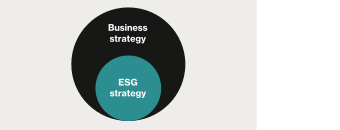
SoftwareOne’s ESG program comprises four pillars: environment, services and solutions, social, and governance. Our ESG program complements and reinforces our business strategy by including services and solutions as one of the four ESG pillars. Refining and scaling up our existing ESG-related services and solutions (e.g., cloud sustainability to measure customers’ carbon footprint) directly contributes to revenue generation associated with our three business lines.
SoftwareOne can also benefit from positive employer branding and greater customer engagement as our wide-ranging ESG initiatives resonate with existing and prospective employees and customers. The ESG program is designed to benefit all SoftwareOne stakeholders, whether internal or external.
Our AI strategy enhances both customer solutions and internal operations. For customers, our professional and managed services deliver tailored, outcome‑driven solutions, with AI agents accelerating service delivery through intelligent automation. Internally, AI‑driven automation and decision‑support tools empower employees, increasing productivity and supporting operational excellence.
Moreover, we have two high‑impact platforms – SoftwareOne Marketplace and Cloud‑iQ. Marketplace is a global, multi‑vendor digital procurement platform that centralizes software discovery, purchasing, subscription management, contracts, and renewals. Cloud‑iQ delivers advanced cloud and software subscription management, billing, cost optimization, analytics, and global channel management through a unified interface.
Our formidable go-to-market engine utilizes extensive customer data and insights to identify targeted, scalable sales opportunities and sales‑play strategies across both direct and channel motions.
Material IROs and their interactions with our strategy and business model
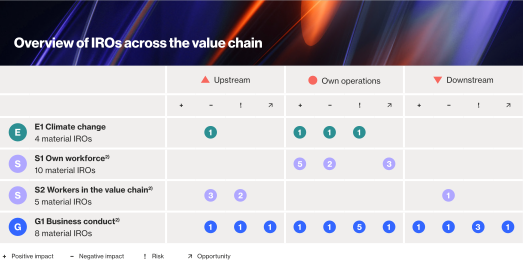
2)Includes some entity-specific material topics.
Note: In total, there are 27 material IROs. Some of the IROs within S2 Workers in the value chain and G1 Business conduct are duplicated because they appear in multiple parts of the value chain. This results in a total of 37, which exceeds the 27 IROs identified in our double materiality assessment. The following topical standards are not material to SoftwareOne: E2 Pollution, E3 Water and marine resources, E4 Biodiversity and ecosystems, E5 Resource use and circular economy, S3 Affected communities, S4 Consumers and end-users.
Material IROs, business strategy, and resilience
Our 27 material IROs will directly influence our planned ESG strategy due to be launched in 2026. In this way, the DMA indirectly supports our business strategy and model, as the ESG strategy complements and strengthens our overall direction. Additional information regarding IRO linkages with business strategy is provided in the respective topical standards.
While we made reasonable efforts to understand the nature of our material risks and opportunities, our analysis did not extend to their current and anticipated effects on our financial performance and cash flows as reported in our financial statements.
We did not perform either a qualitative or quantitative analysis to determine SoftwareOne’s ability to address our material impacts and risks, or to take advantage of our material opportunities. We therefore do not have insights into the resilience of our business strategy and business model in relation to our material sustainability IROs. At best, we can present our various current and planned actions and initiatives in the respective topical standards in the sustainability statements.
Additional information
For more information about our strategy and business model, including our ESG strategy, please refer to the following sections of the annual report:
Our strategy and business modelOur approach to sustainability