Executive Board compensation
Elements of compensation
The compensation framework for members of the Executive Board (EB) consists of fixed and variable compensation elements. The fixed compensation element comprises a base salary as well as pension and other benefits (e.g. car allowances). The variable compensation element consists of a Short-Term Incentive (STI) plan and a Long-Term Incentive (LTI) plan. The payout or vesting of variable compensation elements is subject to performance, including SoftwareOne share performance, financial and strategic successes, and ESG progress. The EB compensation elements are summarized in the following table:
Fixed compensation elements | Variable compensation elements | |||
ELEMENTS OF COMPENSATION | Base salary | Pension and other benefits | Short-Term Incentive plan | Long-Term Incentive plan |
Purpose | Attract, retain, and reward the roles and responsibilities of respective functions | Participation in pension, insurance care plans, and additional benefits in line with local market practice | Motivation and reward for annual objective achievements (company and individual goals) | Participation in the long-term success of SWO and alignment with shareholder interests |
Performance period | - | - | One year | Three years |
Performance measures | - | - | Revenue growth, EBITDA margin, NWC, ESG and strategic goals | Relative Total Shareholder Return (rTSR) |
Payout range | - | - | 0 to 200% of target STI | 0.0 to 2.0 times number of granted performance share units (PSUs) |
Payment | Cash | Contributions to pension and insurance plans | Cash | Shares |
Other benefits paid out in cash | ||||
Fixed compensation elements
Base salary
The base salary for members of the EB is typically paid in cash on a monthly basis unless local laws require otherwise. The base salary amount is defined according to market practice and the responsibility, experience, and achievements of each member.
Pension and other benefits
Pension benefits are provided through SoftwareOne’s regular pension plan. As the EB members reside in different international locations, some EB members are employed under a foreign employment contract and receive benefits in line with current local market practice. In addition to pension coverage, other benefits such as health care plans, insurance, car allowances, or equivalent contributions are also covered. These allowances are paid together with the EB members’ base salary and are in line with the company policy in the local jurisdiction.
Furthermore, new members joining the EB may receive compensation for the loss of their remuneration or for financial disadvantages incurred as a result of changing their jobs. If applicable, such lost compensation is replaced on a like-for-like basis (i.e. no increase in replacement value) and reported in the compensation table for the relevant reporting period under “Other benefits”.
Variable compensation elements
Short-Term Incentive (STI) plan
The STI rewards overall company performance as well as the EB members’ individual contribution to the success of SoftwareOne, in line with the compensation principle of pay-for-performance. The STI outcome is determined by the achievement of financial and strategic goals.
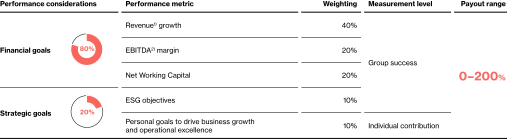
Starting from 2025, Net Working Capital, measured as the year-on-year change in CHF, was introduced as an explicit performance metric (weighted at 20%), complementing the existing financial goals based on revenue growth (weighted at 40%) and EBITDA margin (weighted at 20%). Together, these financial goals account for 80% of the STI.
Strategic goals account for the remaining 20% and comprise ESG objectives (weighted at 10%) as well as strategic personal goals to drive business growth and operational excellence (weighted at 10%). ESG objectives are defined across key focus areas and include environmental initiatives such as leadership training on carbon reduction and emissions awareness, social priorities focused on diversity and inclusion through global “Women in Tech” engagement and leadership development programs, as well as governance-related objectives aimed at strengthening leadership accountability, compliance awareness, and ethical conduct across the organization. Personal goals are determined for each EB member and reflect their individual functional duties and responsibilities.
The table below illustrates the details on the STI performance metrics in terms of definition, weighting, and payout range for the CEO and the other EB members:
1)For the purposes of the STI, revenue is measured on a combined like-for-like basis in constant currency and defined as gross sales of services and software, with the cost of purchasing software deducted.
2)For the purposes of the STI, EBITDA margin means the adjusted EBITDA margin as disclosed in the Annual Report and EBITDA being defined as earnings before interests, tax depreciations, and amortizations.
At the end of the performance period, the NCC proposes and the BoD approves the financial performance achievements and ESG progress against the set group targets. EB members’ individual contributions to SoftwareOne’s success, as measured by the achievement of strategic goals, are initially evaluated by the Co-CEOs, reviewed by the NCC, and approved by the BoD, while the achievement of strategic objectives established for the Co-CEOs is evaluated by the NCC and approved by the BoD. Under specific circumstances, the BoD may apply discretion in interpreting the NCC’s recommendation regarding the final STI payout.
Given their commercial sensitivity, the company does not disclose performance targets upfront, as this could potentially place SoftwareOne at a competitive disadvantage. To enhance transparency in compensation decisions, certain information on the performance targets and achievements relevant to the STI payout factor for the 2025 financial year is retrospectively disclosed in the section STI 2025. The payout of the STI is made entirely in cash.
Long-Term Incentive (LTI) plan
SoftwareOne’s compensation framework is completed by an equity-based element, which was introduced in 2020. It offers executives and selected senior managers the opportunity to participate in the long-term success of the group. The goal of this plan is to provide eligible participants with attractive, market-aligned rewards to strengthen management’s interest alignment with that of shareholders, and to encourage sustainable long-term value creation for shareholders and the company.
At the beginning of each three-year performance period (i.e. at grant date), eligible participants are granted an individual number of performance share units (PSUs) derived by dividing the individual LTI award (in CHF) by the fair value at grant date (in CHF). After the conclusion of the three-year performance period, the PSUs vest subject to performance and service conditions.
As of the 2025 grant, the performance condition is based exclusively on relative total shareholder return (TSR). Relative TSR compares SoftwareOne’s TSR performance against that of the SPI Extra Index, thereby reflecting the market environment relevant to the company’s predominantly Swiss and European investor base.
The vesting outcome ranges between 0.0x and 2.0x of the PSUs granted at the outset. If performance falls below the minimum threshold, the resulting vesting multiple is 0.0x and no PSUs vest. Maximum performance results in a vesting multiple capped at 2.0x.
At the beginning of each performance period, the BoD, upon the NCC’s recommendation, determines the performance targets and the corresponding vesting curve for relative TSR. This determination is supported by a comprehensive evaluation process that considers the company’s strategic performance ambitions and the prevailing market environment.
The overall vesting factor is determined at the end of the three-year performance period. The NCC reviews the performance outcomes and proposes the resulting vesting factor for the approval by the BoD.
To provide transparency on the robustness of the LTI plan design and the level of performance and risk embedded in the plan, the company discloses information on the target-setting process and the shape of the vesting curve in the section LTI 2025: target setting. In addition, the section LTI 2022: performance achievements and vesting provides information on performance outcomes and the resulting vesting level for the 2022 LTI grant.
In the event of a change of control, the LTI plan terminates as of the effective date of the change of control, unless the BoD decides otherwise at its discretion.
Risk-alignment under variable compensation plans: clawbacks and forfeitures
Under the STI, in case of termination of employment during the performance period, the payout may be reduced or forfeited depending on the conditions of such termination and subject to the applicable law. Under the LTI, a service condition requires continuous employment of the plan participant until vesting. In case of termination of employment, either no PSUs or a reduced number of PSUs vest, depending on the conditions of such termination and subject to the applicable law.
As of 2021, a clawback provision, which allows for a partial or full recovery of equity allocated to EB members under the Long-Term Incentive plan, was introduced. This applies in specific situations which may cause reputational damage to the group, in case of restatements of previously audited consolidated financial statements for example, or which may otherwise negatively affect the legitimate interests of SoftwareOne. This provision was also expanded in 2023 to cover the Short-Term Incentive Plan.
Compensation awarded to the Executive Board in 2025
The following table outlines details concerning the compensation awarded to the (former) CFO Rodolfo Savitzky as the highest-paid member of the EB and to the other EB members from January 1 to December 31, 2025. The total compensation awarded in 2024 is also listed.
Audited in CHF | Fixed compensation | Variable compensation | Total compensation FY 20255) | Total compensation FY 20246) | |||
Base salary | Social security contributions | Other payments3) | Realized STI | Awarded LTI grant value4) | |||
Rodolfo Savitzky, CFO1) | 625,000 | 87,529 | 74,526 | 531,250 | 0 | 1,318,305 | 1,808,034 |
Aggregate amount of other EB members2) | 2,463,453 | 275,280 | 357,102 | 782,766 | 1,320,250 | 5,198,851 | 12,147,386 |
Total | 3,088,453 | 362,809 | 431,628 | 1,314,016 | 1,320,250 | 6,517,156 | 13,955,420 |
1)Rodolfo Savitzky was active as CFO until May 31, 2025 with the employment relationship ending February 28, 2026.
2)Please note that one is compensated in SGD (average exchange rate in 2025 of CHF 1 to SGD 1.5759 applied), one in USD (average exchange rate in 2025 of CHF 1 to USD 1.207 applied), and the other EB members in CHF.
3)Other payments comprise payments related to further benefits granted (e.g. insurance, car allowance, pension).
4)For details regarding the grant logic and the calculation of the fair value at grant date, refer to the financial notes.
5)Figures include Raphael Erb, Julia Braun, Oliver Berchtold, and Rodolfo Savitzky. Figures also include Melissa Mulholland, who joined the EB effective July 3, 2025, as Co-CEO and Hanspeter Schraner, who joined the EB effective June 1, 2025, as CFO. It also includes Bernd Schlotter, who was active as President Software & Cloud until November 30, 2024 with the employment relationship ending May 31, 2025.
6)Figures reflect EB composition during 2024 and include Raphael Erb, Julia Braun, Oliver Berchtold, Brian Duffy, Rohit Nagarajan, Bernd Schlotter, Rodolfo Savitzky, Dieter Schlosser, and Neil Lomax.
Approved versus total compensation awarded to the Executive Board
The total compensation for the EB for 2025 of CHF 6.5 million (including social security contributions) is below the total maximum aggregate compensation amount of CHF 19.7 million, which was approved by the AGM in May 2024.
Compensation mix
In 2025, the total target compensation of the Co-CEOs Melissa Mulholland and Raphael Erb was split into 44% variable compensation and 56% fixed compensation. Of the 44% variable target compensation portion, 21% consisted of the target STI and 23% of the target LTI portion. For the other EB members Julia Braun, Oliver Berchtold, and Hanspeter Schraner, the fixed compensation was on average 51% (45–55%) and the variable compensation 49% (45–55%). The variable target compensation consisted of 22% (20–24%) target STI and 27% (24–33%) target LTI of the total target compensation.
STI 2025: target setting, performance achievement, and payout
At the beginning of the one-year performance period, the NCC proposes, and the BoD approves, the minimum, target, and maximum achievement for the respective performance metrics under the STI. For performance below or at the minimum, 0% is paid out. On-target performance is rewarded with a 100% payout. In case of overperformance, up to 200% can be achieved when meeting the maximum. This means that the payout curves for both financial KPIs are symmetrical.
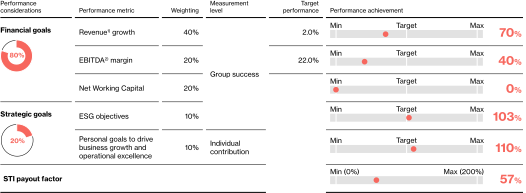
In the financial year 2025, SoftwareOne reached a significant strategic milestone with the successful completion of the Crayon acquisition. Financial performance reflected a transitional year shaped by integration activities and continued strategic execution. Revenue increased by 1.4% on a combined like-for-like basis, as strategic initiatives gained traction during the integration phase, resulting in a solid level of achievement under the Short-Term Incentive plan. Disciplined cost management and continued operational focus supported an adjusted EBITDA margin of above 20%. While profitability remained resilient in a year characterized by integration complexity, performance against the predefined EBITDA target resulted in a partial achievement under the Short-Term Incentive framework. Throughout the integration phase, SoftwareOne maintained a clear focus on working capital discipline and cash generation. Despite these efforts, performance against the predefined Net Working Capital target remained below the minimum payout level.
Our progress regarding ESG initiatives was overly achieved, resulting in a degree of performance achievement of 103%. This reflects in view of environmental goals the successful completion of the carbon reduction training by all EB members and the overachievement of the reforestation target. Social objectives were also exceeded, with “Women in Tech” engagement expanded to 12 employee resource groups (vs. 10 targeted) and female participation in SOAR intakes reaching 66%, above the 50% target. Governance objectives were achieved following a revised scope after the merger, including the roll-out of new company values, vision and mission, and refreshed compliance trainings with completion rates from 89% to 96%.
The BoD assessed the individual contributions of the EB members against the attainment of strategic goals supporting business growth and operational excellence. Particular consideration was given to the effective leadership during the Crayon integration, the delivery of key integration milestones, and the disciplined execution of strategic and operational priorities in a transitional year. In light of the overall leadership contribution and the successful advancement of SoftwareOne’s strategic agenda, the BoD concluded that individual performance exceeded target expectations and set the achievement level for the individual goals at 110% for all EB members. Taking into account the financial, ESG, and individual performance results, the STI payout for 2025 was determined at 57% for all EB members, reflecting the overall performance outcome under the 2025 STI.
1)For the purposes of the STI, revenue is measured on a combined like-for-like basis in constant currency and defined as gross sales of services and software, with the cost of purchasing software deducted.
2)For the purposes of the STI, EBITDA margin means the adjusted EBITDA margin as disclosed in the Annual Report and EBITDA being defined as earnings before interests, tax depreciations, and amortizations.
LTI 2025: target setting
At the beginning of each performance period, the BoD determines the minimum, target, and cap levels for the LTI performance metric, based on the NCC’s recommendation. These levels apply to the three-year performance period.
The calibration follows a structured evaluation process that considers SoftwareOne’s strategic ambitions, long-term financial planning, and the prevailing market environment. The minimum, target and cap levels are designed symmetrically around the target to promote a balanced pay-for-performance profile for outcomes below and above the target. Statistical analyses support this calibration and aim to reflect a realistic likelihood of performance-based pay outcomes over time.
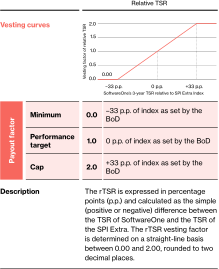
Performance is measured based on relative TSR against the SPI Extra Index. A relative underperformance or outperformance of 33 percentage points defines the minimum and cap levels, respectively, while performance in line with the SPI Extra Index results in a 100% achievement rate. The corresponding minimum, target and cap levels are illustrated in the graph below.
LTI 2022: performance achievement and vesting
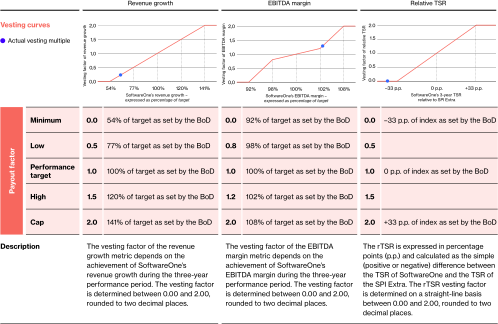
For the LTI 2022 grant, which vested in 2025, performance was measured over the financial years 2022 to 2024 against three performance metrics: revenue growth, EBITDA margin, and relative TSR. Actual performance against the revenue growth metric was underachieved below target, but above threshold, resulting in a vesting multiple of 0.23, accounting for 40% of the LTI 2022 vesting. EBITDA margin performance led to an overachievement, resulting in a vesting multiple of 1.33, accounting for 40% of the LTI 2022 vesting. Relative TSR performance amounted to an underperformance of 53 percentage points versus the SPI Extra Index, resulting in a vesting multiple of 0.00, accounting for 20% of the LTI 2022 vesting. Overall, the total weighted vesting factor for the LTI 2022 was 0.62. The total number of PSUs that vested to all participants (EB and non-EB members) in 2025 amounts to 316,752.
Share ownership
In 2021, SoftwareOne introduced ownership requirements for the EB members with a five-year build-up period. The minimum shareholding requirement was set at 300% and 200% of base salary for the CEO and other EB members, respectively. Since their introduction, EB members have been building their individual shareholdings in SoftwareOne in line with these requirements. In light of changes in the composition of the Executive Board and given that none of the current members of the Executive Board has held this position for more than five years, the first formal compliance assessment will take place in 2028.
The table below shows the shareholdings of each EB member as at December 31, 2025, considering the number of directly held shares and options (excluding unvested LTI performance share units). The total shareholdings as at December 31, 2024 are also listed:
Audited EB members | Total shareholdings as at December 31, 2025 | Total shareholdings as at December 31, 2024 |
Raphael Erb1) | 543,653 | 524,665 |
Melissa Mulholland2) | 36,778 | - |
Julia Braun | - | - |
Oliver Berchtold3) | 204,379 | 197,117 |
Hanspeter Schraner4) | - | - |
Rodolfo Savitzky5) | 90,617 | 53,340 |
Bernd Schlotter6) | - | - |
Total | 875,427 | 775,122 |
1) Shareholdings also include shareholdings from entities under significant influence. Raphael Erb also owns 2,000 call options for 100 shares, each call option with an expiry date of December 18, 2026, and an exercise price of CHF 8. He also owns 500 call options for 100 shares, each call option with an expiry date of December 18, 2026, and an exercise price of CHF 10.
2) Melissa Mulholland joined the EB effective July 3, 2025, as Co-CEO. Shareholdings also include shareholdings from related parties.
3) Oliver Berchtold also owns 1,000 call options for 100 shares, each call option with an expiry date of June 18, 2027, and an exercise price of CHF 10.
4) Hanspeter Schraner joined the EB effective June 1, 2025, as CFO.
5) Rodolfo Savitzky was active as CFO until May 31, 2025, with the employment relationship ending February 28, 2026.
6)Bernd Schlotter was active as President Software & Cloud until November 30, 2024, with the employment relationship ending May 31, 2025.
Further compensation information
Employment agreements
All members of the EB have employment contract agreements with a six- to twelve-month notice period, which are governed by the applicable laws. They are not entitled to severance payments.
Their employment agreements also prohibit the EB members from competing against SoftwareOne for a period of up to 12 months after termination of their employment contract. For the specified non-competitive period, SoftwareOne agrees to pay compensation to the EB member for their compliance with this non-competitive undertaking to an amount equal to 80% of their last base salary (excluding any ancillary benefits and subject to deduction of any social security and further deductions). This is payable in arrears in monthly instalments, for as long as the EB member complies with the non-competitive agreement. However, SoftwareOne may, at any time up to two months prior to the last day of employment, waive the non-competitive obligation, whereupon such payments will no longer be due.
Settlement of outstanding Crayon 2025 LTI Award
Following SoftwareOne’s acquisition of Crayon and considering Crayon’s subsequent delisting, the outstanding long-term incentive award granted to Melissa Mulholland under Crayon’s 2025 LTI plan, in the form of conditional shares with a value of NOK 2’000’000, was converted into a cash-settled program at closing. This treatment was in line with the applicable plan rules and was approved by Crayon’s Board of Directors. The award will be paid in six equal tranches over a period of 36 months (starting from July 2025), thereby maintaining the originally intended long-term payout horizon. Vesting of each tranche is conditional upon the participant remaining employed within SoftwareOne at the respective vesting date, with no notice of termination having been given or received at that time.
Payments to current or former members of the EB
No further payments other than those set out in the compensation table for EB members were made to current or former EB members or closely related persons.
Loans to members of the EB
Article 23 of SoftwareOne’s Articles of Incorporation allows for loans and credits of up to CHF 1,000,000 at market-based conditions to be granted to EB members. In 2025, no loans or credits were made to EB members.