E1 Climate change
SoftwareOne is guided by the international scientific consensus that climate change is driven by a recent and significant rise in anthropogenic greenhouse gas emissions.
Processes to identify and assess climate-related IROs
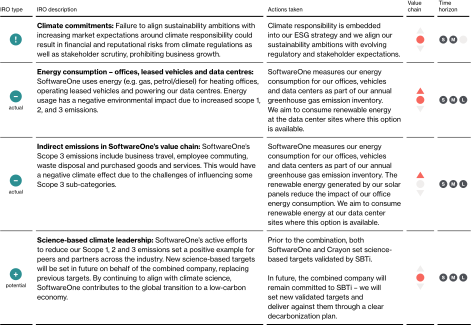
Our double materiality assessment (DMA) identified four climate-related impacts, risks and opportunities (IROs). The process we followed was the same for the whole DMA, as described in the Double materiality assessment section in ESRS 2.
In assessing climate impacts, we considered our historical greenhouse gas emissions, recognizing that our Scope 3 emissions likely represent our greatest potential to mitigate climate change.
The DMA identified one positive climate-related impact and two negative climate-related impacts. SoftwareOne has not performed a climate risk analysis, however, we plan to conduct such an analysis in the future. We do not yet have a time-bound plan for when we will conduct a climate risk analysis. Financial effects from material physical and transitional risks and potential climate-related opportunities have not been assessed.
None of the climate-related IROs relate to physical risks or climate-related hazards. One risk was identified through our DMA, but no associated transition events were analyzed nor how SoftwareOne’s assets and business activities might be exposed to transition events.
We did not conduct a climate scenario analysis or assess the resilience of our business strategy and model in the context of our material climate-related IROs. This also applies to the compatibility of our assets and business activities with the transition to a climate- neutral economy. Similarly, we are not in a position to quantify the anticipated financial effects and potential benefits from climate-related risks (physical and transition) and opportunities in concrete terms.
The only material climate-related risk we identified in our double materiality assessment was related to SoftwareOne’s ability to align sustainability ambitions with increasing market expectations around climate responsibility.
Specifically, there is a potential risk that we could face financial and reputational damage from climate regulations as well as stakeholder scrutiny, preventing business growth if we do not uphold our sustainability commitments. This is against the backdrop of the heightened market expectations we have observed in recent years regarding companies’ climate commitments.
This risk, considered a transition risk, applies to our own operations.
Policies related to climate change
SoftwareOne has had a global Environmental Policy in place since 2023, covering a wide range of commitments that SoftwareOne and our employees adhere to. These commitments are integral to the way we operate. The policy aims to help mitigate climate change and outlines our commitments to being an environmentally responsible business focusing on carbon reduction initiatives, identifying and complying with existing legal environmental regulations, and measuring our carbon footprint. Our Environmental Policy is enforced within our offices where we implement our green office initiative which focuses on implementing energy efficient practices. This policy aims to mitigate risks related to climate commitments reduce our impacts related to energy consumption.
Governance
SoftwareOne’s Global ESG Team administers our Environmental Policy and measures our greenhouse gas emissions. The team is led by the Global Head of ESG, who in turn, reports to the Chief Strategy and Integration Officer.
Accessibility
The global Environmental Policy is available for all employees on SoftwareOne’s ESG SharePoint page.
Remuneration
In 2025, climate-related metrics were not included in the remuneration of any employees, the EB or BoD members.
Actions related to climate change in 2025
SoftwareOne has not implemented material climate change mitigation or adaptation actions beyond existing operational measures. No significant capital or operational expenditures have yet been formally allocated to specific climate transition initiatives.
In 2025, SoftwareOne did not have formal transition or decarbonization plans in place. We commit to developing an ESRS-aligned climate transition plan in the future. Future actions, including defined decarbonization measures, resource allocation, timelines and associated investments, will be established and implemented in alignment with this transition plan. Progress against these actions will be disclosed in subsequent reporting periods in accordance with ESRS E1 requirements.
Performance related to climate change in 2025
The year 2025 marks SoftwareOne’s first year reporting according to CSRD and includes Crayon which was acquired in July. These developments have introduced significant methodological and internal control challenges in collecting, consolidating, and reporting GHG emissions and energy consumption data. As a result, we recognize that there are some data uncertainties and weaknesses.
The information presented under ‘Our GHG emissions’ and ‘Our energy consumption and mix’ is based on the best available data at the time of reporting and is considered a reasonable representation of SoftwareOne’s emissions and energy consumption footprint. We remain committed to enhancing data completeness and accuracy for future reporting.
Our GHG emissions
We perform an annual GHG inventory that measures our Scope 1, 2 and 3 emissions. Our GHG inventory covers our operations worldwide and is reported to the CDP5). SoftwareOne’s emissions are calculated in line with ESRS and the applicable international GHG Protocol standards. In 2025, our GHG Inventory covers Scope 1, 2, and 3 emissions for SoftwareOne FY2025 and Scope 1, 2, and 3 emissions for Crayon for FY2025 H2.
5)Formerly known as the Carbon Disclosure Project, the CDP is an international organization that aims to improve organizations’ disclosure of their environmental performance by producing annual questionnaires on climate change, supply chain, water, and forests. In 2025, SoftwareOne and Crayon obtained two separate CDP scores. In 2026, we will disclose through CDP as the combined company under the name SoftwareOne.
GHG inventory
Scope 1 GHG emissions | Unit | 2025 |
Gross Scope 1 GHG emissions | Tons of CO2e (tCO2e) | 774.09 |
Percentage of Scope 1 GHG emissions from regulated emission trading schemes | % | 0.00 |
Scope 2 GHG emissions | Tons of CO2e (tCO2e) | |
Gross location-based Scope 2 GHG emissions | Tons of CO2e (tCO2e) | 3,961.10 |
Gross market-based Scope 2 GHG emissions | Tons of CO2e (tCO2e) | 4,534.07 |
Significant Scope 3 GHG emissions | Tons of CO2e (tCO2e) | |
Total gross indirect Scope 3 GHG emissions | Tons of CO2e (tCO2e) | 18,903.79 |
Category 1: Purchased goods and services | Tons of CO2e (tCO2e) | 3,956.28 |
Category 2: Capital goods | Tons of CO2e (tCO2e) | 2,571.18 |
Category 3: Fuel and energy related activities | Tons of CO2e (tCO2e) | 1,171.26 |
Category 4: Upstream transportation and distribution | Tons of CO2e (tCO2e) | 52.60 |
Category 5: Waste generated in operations | Tons of CO2e (tCO2e) | 684.21 |
Category 6: Business travel | Tons of CO2e (tCO2e) | 6,433.35 |
Category 7: Employee commuting | Tons of CO2e (tCO2e) | 2,548.49 |
Category 8: Upstream leased assets | Tons of CO2e (tCO2e) | 1,486.42 |
Category 11: Use of sold products* | Tons of CO2e (tCO2e) | 0.00 |
Total GHG emissions | Tons of CO2e (tCO2e) | |
Total location-based emissions (Scope 1+2+3) | Tons of CO2e (tCO2e) | 23,638.99 |
Total market-based emissions (Scope 1 + 2 +3) | Tons of CO2e (tCO2e) | 24,211.96 |
*Scope 3 Category 11: SoftwareOne has a small share of revenue associated the sale of hardware. Due to the minor financial materiality of this activity, emissions associated with the use of sold products are estimated to be low. We are working to improve data completeness to disclose these emissions in our 2026 reporting.
Emissions intensity
Unit | 2025 | |
Location-based emissions intensity | ||
Emission intensity/employee (physical intensity) | Ton/FTE | 1.86 |
Emission intensity/employee (physical intensity) | Ton/headcount | 1.82 |
Emission intensity/revenue (economic intensity) | Ton/million (CHF) | 0.0000190 |
Market-based emission intensity | ||
Emission intensity/employee (physical intensity) | Ton/FTE | 1.90 |
Emission intensity/employee (physical intensity) | Ton/headcount | 1.87 |
Emission intensity/revenue (economic intensity) | Ton/million (CHF) | 0.00001947 |
Values used to normalize our emission data and calculate emission intensity | ||
Employee | Full-time equivalent employees (FTEs) | 12,712 |
Employee | Headcount | 12,973 |
Revenue | Millions (CHF) | 1,243.4 |
For FY2025, the net revenue used for the calculation of GHG emissions intensity is consistent with the amount presented in note 6 Revenue of the consolidated financial statements of SoftwareOne. No adjustments were made to the reported net revenue for the purpose of calculating the emissions intensity metric.
Progress
In 2025, our GHG inventory included Scope 1, 2, and 3 emissions for SoftwareOne FY2025 and Scope 1, 2, and 3 emissions for Crayon FY2025 H2.
Key drivers:
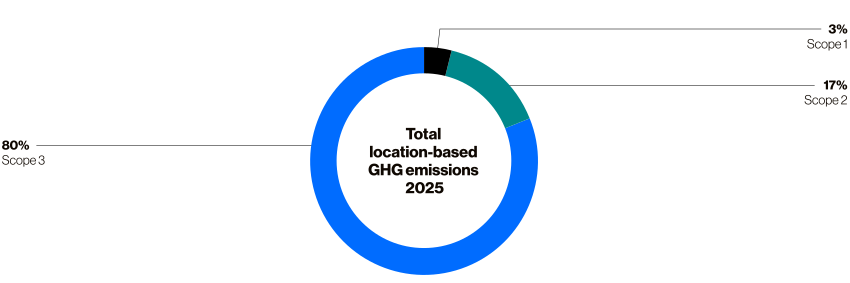
Within Scope 1, 20% of total Scope 1 location-based emissions came from natural gas for heating. The remaining 80% came from petrol and diesel used by our leased vehicles, refrigerants (fugitive emissions), and diesel consumed by generators.
Within Scope 2, purchased electricity accounted for 97% of our total Scope 2 location-based emissions, with heat and steam contributing 3%.
Within Scope 3, business travel is the largest contributor (34% of Scope 3, 27% of total location-based emissions), followed by purchased goods and services (21% of Scope 3, 17% of total location-based emissions).
To prepare for reporting our 2025 GHG inventory we focused on:
- Establishing the combined company’s boundaries for reporting.
- Rolling out data collection training across the combined company.
- Using one external online carbon accounting tool.
- Expanding the number of reported Scope 3 categories to nine.
Our energy consumption and mix
In 2025, SoftwareOne consumed a total of 22,029.27 MWh of energy across its operations.
In 2025, 86.5% of our total energy consumption came from fossil fuel sources and 13.5% of our total energy consumption came from renewable energy sources.
Due to data constraints, the percentage of our total energy consumption derived from nuclear energy sources in 2025 is not known.
SoftwareOne falls under NACE code K.62.206) and is therefore not in a high climate impact sector.
6)Computer consultancy and computer facilities management.
Energy consumption in SoftwareOne’s own operations
Energy consumption and mix (MWh) | 2025 |
Fuel consumption from diesel, petrol, average fuel | 3,492.52 |
Fuel consumption from natural gas | 466.49 |
Consumption of purchased or acquired electricity heat, steam, and cooling | 15,100.68 |
Total fossil energy consumption | 19,059.69 |
Share of fossil sources in total energy consumption (%) | 86.5% |
Consumption of purchased or acquired electricity, heat, steam and cooling from renewable soruces | 2,969.58 |
Total renewable energy consumption | 2,969.58 |
Share of renewable sources in total energy consumption (%) | 13.5% |
Total energy consumption | 22,029.27 |
Targets
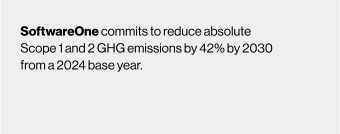
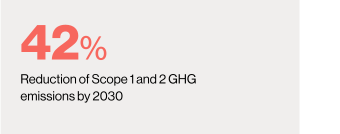
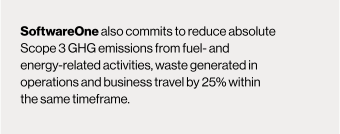
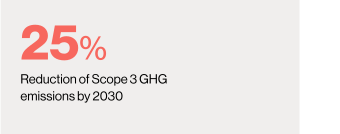
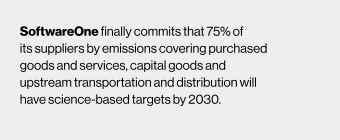
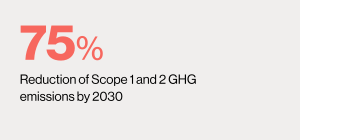
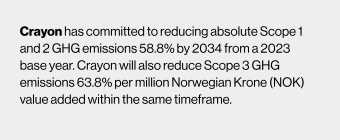
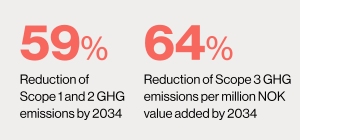
SoftwareOne and Crayon set separate science-based targets in 2025 ahead of the combination. These targets were validated by the SBTi and are aligned with the Paris Agreement. These science-based targets of SoftwareOne and Crayon respectively were validated prior to the structural changes in 2025 and are therefore no longer representative of the current organizational perimeter following the combination with Crayon. SoftwareOne and Crayon will set combined targets under SoftwareOne in future to reflect the combined company.
Our near-term science-based targets as validated by the SBTi
Plans for 2026
SoftwareOne will develop a new global ESG strategy that aligns with the combined company and will include greenhouse gas emissions and climate-related risk as one of the ESG focus areas between 2026 and 2030. This reinforces the strategic relevance of climate-related IROs in our business model.
Our Environmental Policy will be updated to incorporate new initiatives aligned with the combined company’s science-based targets. The revised policy will also reflect actions related to the combined company future transition plan.
Methodology
SoftwareOne determines our organizational boundary, and thus the activities to be included in the GHG inventory, through financial control.
The financial control principle applies to all emissions in our greenhouse gas inventory:
- Scopes 1 and 2: emissions of all entities over which SoftwareOne has financial control.
- Scope 3: value chain emissions of all entities over which SoftwareOne has financial control.
The reporting period aligns with the 2025 calendar year, which is SoftwareOne’s financial year.
Following the acquisition of Crayon in July 2025, half-year Scope 1, 2, and 3 GHG emissions and energy consumption from Crayon have been included in SoftwareOne’s accounting. Due to data uncertainties arising from the acquisition, a 50% share of Crayon’s 2025 emissions and consumption has been applied. Given Crayon’s stable business model with minimal fluctuations in emissions expected, this proportional approach provides the most representative estimate for the partial-year period.
All material Scope 3 categories were assessed to understand which categories are important, and to comply with the GHG Protocol Scope 3 Standard.
The Scope 1, 2, and 3 footprints have been calculated and reported based on the ESRS.
Emission factors are based on the most recent GWP values published by the IPCC using a 100-year time horizon to calculate CO2 equivalent emissions of non-CO2 gases. Specifically, GWP values from IPCC 2021 AR6 are used when available and AR5 (IPCC 2014) and AR4 (IPCC 2007) are used when the most recent values are not available in certain databases. This follows regulatory guidelines that require the use of the most recent IPCC GWP values with a 100-year time horizon.
SoftwareOne does not permanently remove or actively support the removal of GHG from the atmosphere. SoftwareOne does not purchase or intend to purchase carbon credits from the voluntary market. We therefore, did not include any removals, or any purchased, sold or transferred carbon credits or GHG allowances in the calculation of Scope 1, 2 and 3 GHG emissions.
No emissions were reported under regulated trading schemes, and we did not operate or finance any carbon offset projects or apply internal carbon pricing.
Biogenic emissions
SoftwareOne cannot report on biogenic emissions but we commit to perform an assessment to identify biogenic emissions and report on these emissions in the future. SoftwareOne does not currently have a time-bound plan for when this data will be reported.
Scope 1
Scope 1 emissions were based on natural gas, stationary diesel, refrigerants (including fugitive emissions) and diesel and petrol associated with our leased vehicles. Fuel consumption (activity) data was supplemented with estimates where relevant. We used 2024 emission factors from Department for Energy Security and Net Zero (DESNZ) and DEFRA (Department for Environment, Food & Rural Affairs). Specifically for stationary combustion (boilers, furnaces) we multiply energy consumption by emission factors published by public bodies and agencies including the UK Government, EPA, IEA, and French Environment Agency.
Scope 2
Scope 2 emissions were based on purchased electricity (location- and market-based) as well as purchased heat and steam.
Scope 2 location-based emissions use average grid emission factors from sources like IEA and other authorities for the specific geographic location where electricity is consumed. Market-based emissions follow a hierarchy that includes residual mix factors (like those from AIB’s European Attribute Mix publication) and supplier-specific factors. When residual mix factors are not available for a location, the location-based emission factor is used as a fallback. Where actual energy consumption data was unavailable, estimates were applied based on full-time equivalent (FTE) employees or office floor area (square meters).
This approach aligns with GHG Protocol requirements for dual reporting of both location-based and market-based Scope 2 emissions.
Purchased heat and steam in Scope 2 relates to emissions from heating and cooling used in SoftwareOne’s offices across all the countries in which we operate. Emission factors for district heating were based on national public sources such as DEFRA. For heating specifically, the emissions are computed using energy consumption data multiplied by appropriate emission factors from these trusted national sources.
For data centers where we have operational control, our electricity is purchased from the grid and therefore is allocated to Scope 2.
Scope 3
We reported on nine Scope 3 categories which were found to be relevant and applicable to SoftwareOne after a screening exercise.
To identify our material scope 3 categories, we followed a structured approach to map activities, identify emission sources, and assess the likely size of emissions for each category based on our operations.
Scope 3 categories determined to be not material to SoftwareOne must meet at least one of three criteria:
- Size: The category contributes insignificantly to our total Scope 3 emissions.
- Influence: We have limited ability to collect data or influence reductions in that area.
- Business relevance: The activity genuinely does not apply to our business model or operations.
Below, we summarize the categories assessed as not-material and provide justification for their exclusion.
Not-material Scope 3 categories
Scope 3 categories not relevant and applicable to SoftwareOne | Reason for exclusion |
Category 9: Downstream transportation and distribution | SoftwareOne has a minor share of revenue associated with the sale of hardware. The transport and distribution of sold products is largely paid for by SoftwareOne. Therefore, emissions for instances where transport and distribution are covered by the customer are assessed to be insignificant. Further, we have limited ability to collect data or influence reductions related to this transport and distribution. |
Category 10: Processing of sold products | Products sold by SoftwareOne do not require further processing. |
Category 12: End-of-life treatment of sold products | SoftwareOne sells intangible digital products that do not generate physical waste requiring end-of-life treatment. |
Category 13: Downstream leased assets | SoftwareOne has no downstream leased assets |
Category 14: Franchises | SoftwareOne has no franchises |
Category 15: Investments | SoftwareOne has no financed emissions. Any equity stakes are assessed under the operational control approach and excluded if emissions are considered insignificant. |
Scope 3 emissions were calculated using 2024 emission factors from reliable databases including EPA, DEFRA, IEA, and environmentally-extended input-output databases like EXIOBASE and USEEIO. The World Input-Output Database and Open Input Output Database are used for spend-based calculations in Scope 3. The graph below shows material Scope 3 categories broken down by their percentage contribution to our overall Scope 3 emissions.
in %
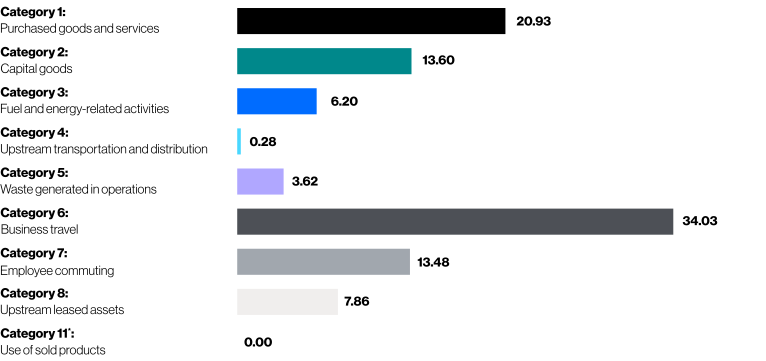
*Scope 3 Category 11: SoftwareOne has a small share of revenue associated the sale of hardware. Due to the minor financial materiality of this activity, emissions associated with the use of sold products are estimated to be low. We are working to improve data completeness to disclose these emissions in our 2026 reporting.
Category 1: Purchased goods and services
Calculations for this category are based on spend data from SoftwareOne’s financial reporting systems, where expenses are logged by each subsidiary and uploaded to our external GHG data platform. These are mapped to spend-based emission factors.
Expenses include a broad range of goods and services: IT hardware, transportation and logistics, facilities, insurance, office supplies, and more.
Software purchased by SoftwareOne for internal use is included. However, software and cloud licenses sold to customers are excluded, as SoftwareOne acts as an agent for vendors and does not control the delivery or usage in relation to customers.
For leased data centers where we do not have operational control, all emissions (including electricity) fall under scope 3.1 since we are leasing the service. The electricity powering the servers, cooling systems, and other equipment comes from the grid.
Category 2: Capital goods
This category captures upstream emissions from the production of capital goods purchased by SoftwareOne, including buildings, vehicles, machinery, IT equipment, and furniture. Emissions are calculated using a combination of supplier-specific data, hybrid approaches, average-product methods, and spend-based methods, depending on data availability and materiality. Supplier-specific and hybrid methods incorporate cradle-to-gate emissions data obtained directly from suppliers, supplemented with secondary data where necessary, while average-product and spend-based methods apply industry emission factors to activity data such as mass, units, or purchase value.
Cradle-to-gate emission factors are used to ensure full coverage of emissions from raw material extraction through to the point of sale. These factors are sourced from public agencies such as the EPA, UK Government, and ADEME, as well as life cycle assessment databases (e.g., Ecoinvent) and manufacturer-specific disclosures (such as product carbon footprints).
For construction-related capital goods, emissions are estimated using building-specific intensity factors expressed as kg CO2e per square meter, differentiated by building type (e.g., office, data center, warehouse). For renovations and refurbishments, a spend-based approach is typically applied, with the option to incorporate more detailed component-level analysis where higher accuracy is required.
Category 3: Fuel and energy-related activities
This category captures upstream emissions of fuel and electricity used in SoftwareOne’s operations and not already accounted for Scope 1 and Scope 2.
Emissions are calculated by multiplying electricity and fuel consumption quantities by the relevant upstream emission factors. For example, for natural gas this includes Well-to-Tank (WTT) emissions (i.e. before combustion), and for electricity this includes WTT (generation), WTT (transmission & distribution) and transmission and distribution losses emissions.
For purchased fuels like natural gas, we use upstream emission factors that include Well-to-Tank (WTT) emissions and purchased electricity; the upstream factors include WTT emissions from fuel extraction/production for electricity generation, plus transmission and distribution losses.
Category 4: Upstream transportation and distribution
This category captures upstream emissions from the transportation and distribution of products purchased by SoftwareOne, including logistics between suppliers and SoftwareOne’s operations, as well as third-party transport and distribution services. Emissions are calculated using fuel-based, distance-based, or spend-based methods, depending on data availability and the level of detail required.
Fuel-based calculations use actual fuel consumption data from transport providers, applying fuel-specific emission factors. Distance-based methods estimate emissions by multiplying the mass of goods transported by distance travelled and mode-specific emission factors (e.g., road or sea freight). Where primary data is not available, spend-based methods are applied using expenditure data and environmentally extended input-output (EEIO) emission factors.
Emission factors include fuel combustion factors, electricity emission factors for electric transport, and refrigerant leakage factors where relevant. For warehousing and distribution activities, emissions are estimated using site-specific energy consumption data where available, or alternatively through average emission factors based on storage metrics such as pallet count or cubic meter-days.
Emission factors are sourced from recognized databases and authorities, including government agencies (e.g., Defra), GHG Protocol tools, and transport service providers. Where possible, activity-based methods are prioritized to improve accuracy, with spend-based approaches used as a fallback where detailed operational data is unavailable.
Category 5: Waste
Emissions in this category relate to third-party treatment and disposal of operational waste. Waste types include residual waste, sorted and mixed waste, hazardous waste, organic waste, and wastewater.
Calculations are based on either actual reported volumes or estimates per waste type.
SoftwareOne estimates these emissions based on employee count using a kg CO2e per employee ratio, since office waste typically represents a small part of total emissions. The calculation covers disposal, transportation and treatment of all waste our company generates in our offices for which we have financial control.
Category 6: Business travel
This category includes emissions calculated based on:
- Transportation via air, rail, car, and bus.
- Hotel accommodation.
- Distance-based travel allowances.
Business travel calculations start with the spend-based method using accounting data, then we improve the accuracy by collecting actual distance and mode data for significant travel sources.
Emissions were calculated using a combination of spend, distance, fuel and mode of transport, depending on data availability. The emission factors used for business travel include life cycle fuel emission factors that cover the full fuel production and combustion process and Tank-to-Wheel (TTW) emission.
Category 7: Employee commuting
Category 7 covers emissions from employees’ transportation between home and their SoftwareOne office location. It does not include employees travelling in vehicles hired by SoftwareOne or staying in hotels paid for by SoftwareOne – this is captured in Category 6.
Commuting emissions are calculated using a company-wide employee emission survey where employee commuting and working from home habits are captured directly on the external GHG data platform.
Category 8: Upstream leased assets
Category 8 includes the upstream emissions relating to the use of leased assets not accounted for in our Scope 1 or 2 inventory. This includes leased offices in co-working spaces where SoftwareOne does not have financial control.
The actual or estimated consumption per co-working space for purchased electricity, natural gas and refrigerants was multiplied by the appropriate full life cycle emission factor to calculate total emissions.
This category also includes the upstream emissions relating to SoftwareOne’s leased data centers. We use site-specific energy use (electricity, heating, cooling) data then apply emission factors. The key inputs are the data center’s power consumption in kWh.
Category 11: Use of sold products
This category is intended to cover emissions from the use phase of hardware products sold by SoftwareOne through our subsidiary Sensa and SoftwareOne’s niche IT hardware-related activities. These activities and thus the emissions are considered relevant to the business, despite constituting a minor share of total revenue.
Given the low financial materiality, emissions associated with the use of sold products are estimated to be low. We are working to improve data completeness to disclose these emissions in our 2026 reporting.
Software and cloud licenses sold to customers are excluded from this category. SoftwareOne acts as an agent in these transactions and does not control delivery, access, or use.
External validation
Targets relating to climate change are externally reviewed and validated by the Science Based Targets initiative (SBTi). The SBTi has confirmed that SoftwareOne’s and Crayon’s separate targets set prior to the combination are aligned with the latest climate science and are consistent with the goals of the Paris Agreement to limit global warming to well below 2°C, and pursue efforts to limit warming to 1.5°C above pre-industrial levels.