Double materiality assessment
First-time application of the principles of double materiality
SoftwareOne conducted its first DMA aligned with CSRD and ESRS requirements in 2025.
The 2025 DMA replaces our previous materiality assessment, which followed a different methodology and did not represent the combined company.
The DMA forms the basis of the disclosures in the sustainability statements, and it will be reviewed and updated annually. Future updates will include refinements to our process and methodology.
Process to identify and assess material impacts, risks, and opportunities
The 2025 DMA was group-wide and global in scope, applying to all our subsidiaries and entities.
In order to identify the impacts, risks, and opportunities that SoftwareOne and our stakeholders perceive as the most important, we developed a four-step process.
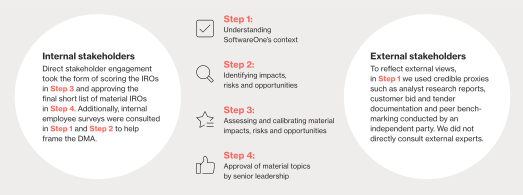
Step 1: Understanding SoftwareOne’s context
To understand sector- and company-specific sustainability matters, we consulted various internal and external sources. We reviewed internal employee surveys, SoftwareOne’s enterprise risk register, external benchmarking of peer companies in the IT industry, ESG legislation, analyst research reports, and a selected sample of customer bids and tender documentation.
This step helped ensure that the DMA was informed by diverse perspectives and had a solid foundation aligned with industry standards and best practices.
Step 2: Identifying impacts, risks, and opportunities
We drew on the previous materiality assessments of SoftwareOne and Crayon respectively, combined with Step 1, to identify a long list of 58 impacts, risks and opportunities. The long list was aligned with the CSRD/ESRS framework and included entity-specific topics or issues.
Step 3: Assessing and calibrating material impacts, risks, and opportunities
To evaluate the materiality of the identified IROs, we involved internal subject matter experts from across the organization. The internal subject matter experts:
- Scored the IROs and provided a rationale for their scores – qualitative and quantitative evaluation to determine impact and financial materiality. We applied the double materiality framework in line with the criteria set forth in ESRS 1.
- Reviewed and commented on the wording of the IROs.
The Global ESG Team further validated the evaluation by the subject matter experts, with targeted input from the Internal Audit function.
Relationship between sustainability due diligence and our DMA
As described in the section Statement on due diligence in ESRS 2, our sustainability due diligence involves multiple corporate functions. Internal subject matter experts whose responsibilities encompass topics such as labor and human rights in our own operations and in our value chain, third party due diligence, and anti-bribery and corruption scored the relevant IROs corresponding with their areas of expertise.
Prioritization, interconnectedness and causality of impacts, risks, and opportunities
We did not place any particular emphasis on identifying activities, business relationships, or geographies that could heighten the risk of adverse impacts. As this was our first DMA, we focused on understanding our material IROs – we did not identify any cases where the same topic gave rise to explicitly interconnected impacts, risks, and opportunities. We distinguished between IROs either caused or contributed to by SoftwareOne, or linked to SoftwareOne. This information was captured as part of the supporting documentation in our DMA process.
Step 4: Approval of material topics by senior leadership
Feedback on, and formal final approval of, the DMA was provided by the EB as well as the BoD.
Scoring of impacts, risks, and opportunities
We used a quantitative approach to assess each IRO, based on ESRS 1 requirements. All items were scored on a scale from 1 to 5, with a defined threshold of 4.0 distinguishing material IROs from immaterial ones. We established qualitative descriptions for each scoring criterion.
The key assumptions made were:
1. In scoring all our IROs, we assumed ongoing integration across all areas of the company and growing cohesion with:
- Our business model and strategy, which emphasises AI in external marketplace offerings and as a business enabler in our internal operations. This view informed the identification and scoring of AI-related IROs, resulting in material entity-specific disclosures in this area.
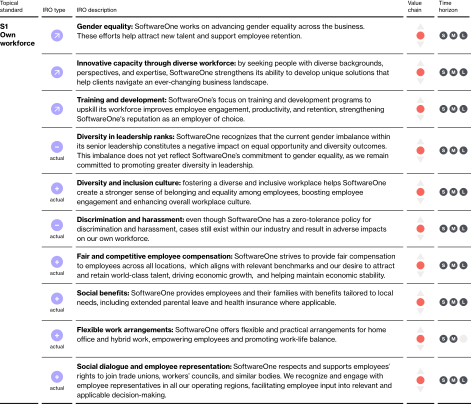
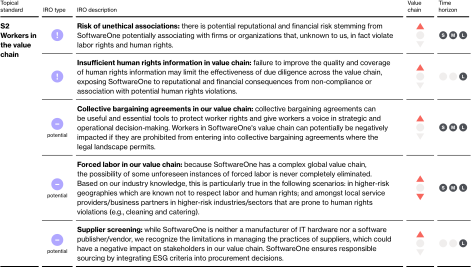
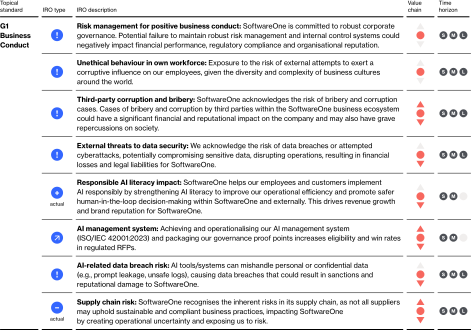
- Our core company values, which include integrity (honesty, transparency, and speaking up) and trust (people-focused) – a significant number of IROs identified were therefore in the social pillar (56% of our material IROs were in S1 and S2), with the governance pillar constituting the second largest category (30% of our material IROs were in G1).
2. In scoring risks and opportunities, we quantified the financial magnitude (financial impact) based on the adjusted EBITDA of the combined company. As the DMA was completed during the year before full-year financial results were available, we relied on projected estimates for adjusted EBITDA. We assumed our projected estimates were reasonably accurate and therefore did not mislead or bias our internal subject matter experts in their scoring.
Scoring of impact materiality
The identified impacts can be classified as a combination of potential/actual and positive/negative. The scoring scale for each criterion was 1 (lowest) to 5 (highest). To arrive at a score for impact materiality, we took into account both severity and likelihood.
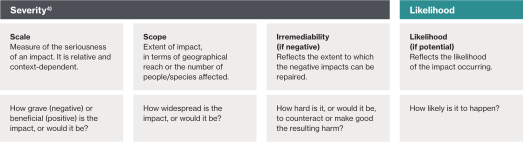
4)Severity score = Scale + Scope + Irremediability* (*if negative)/3
Materiality score for potential impacts (positive or negative): Likelihood score + severity score/2
Materiality score for actual impacts (positive or negative): Severity score = materiality score
Exceptions: human rights impacts (positive or negative, actual or potential) were scored according to severity. Potential positive human rights impacts were scored according to likelihood and severity.
Scoring of financial materiality
Financial effects can be either risks or opportunities. To arrive at a score for financial materiality, we took into account magnitude and likelihood. We aligned the definition of financial magnitude with the definition of financial materiality used internally for financial reporting. The scoring scale for each criterion (magnitude, likelihood) was 1 to 5, where 1 is the lowest possible score and 5 the highest.

Materiality score for either risks or opportunities: Likelihood score + magnitude score/2
Findings from our double materiality assessment
We believe the findings of our 2025 DMA present a true and fair picture of our material impacts, risks, and opportunities based on the information available at the time and any inherent constraints in our methodology. Given that this was our first DMA and first set of material impacts, risks, and opportunities, there are no changes to the IROs compared to the previous reporting period.
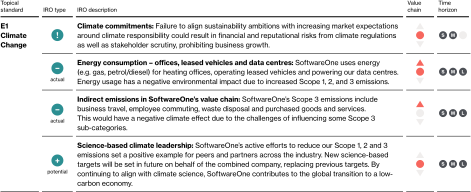
In total, 27 material IROs (impacts, risks, and opportunities) were identified across the environmental, social, and governance pillars. Based on our assessment, four of the ten topical ESRS standards were deemed applicable to SoftwareOne.
Description of our material impacts, risks, and opportunities
More detailed descriptions of our 27 material IROs — such as time horizons and position in the value chain — are provided in the following tables.